AI
Insights
What Does MVP Mean? Understanding Its Definition and Importance

Overview
The term MVP, or Minimum Viable Product, denotes a streamlined version of a product that encompasses only the essential features required to satisfy early adopters and validate a business concept with minimal resources. This approach is pivotal for businesses aiming to gather valuable user feedback, mitigate financial risks, and swiftly adapt their offerings to meet market demands. Consequently, leveraging an MVP significantly enhances the likelihood of achieving long-term success. By focusing on core functionalities, companies can not only test their hypotheses but also refine their products based on real user insights, ultimately fostering a more robust market presence.
Introduction
Understanding the concept of a Minimum Viable Product (MVP) is crucial for startups and established businesses alike, as it serves as a foundational strategy in product development. By concentrating on essential features that meet the needs of early adopters, organizations can validate their ideas while minimizing risk and resource expenditure.
However, as the landscape of product development evolves, a pressing question emerges: how can businesses effectively leverage MVPs not only to test their hypotheses but also to ensure compliance and foster long-term growth?
This exploration delves into the definition, significance, and key characteristics of MVPs, revealing insights that could transform the way companies approach innovation in a competitive marketplace.
Define Minimum Viable Product (MVP)
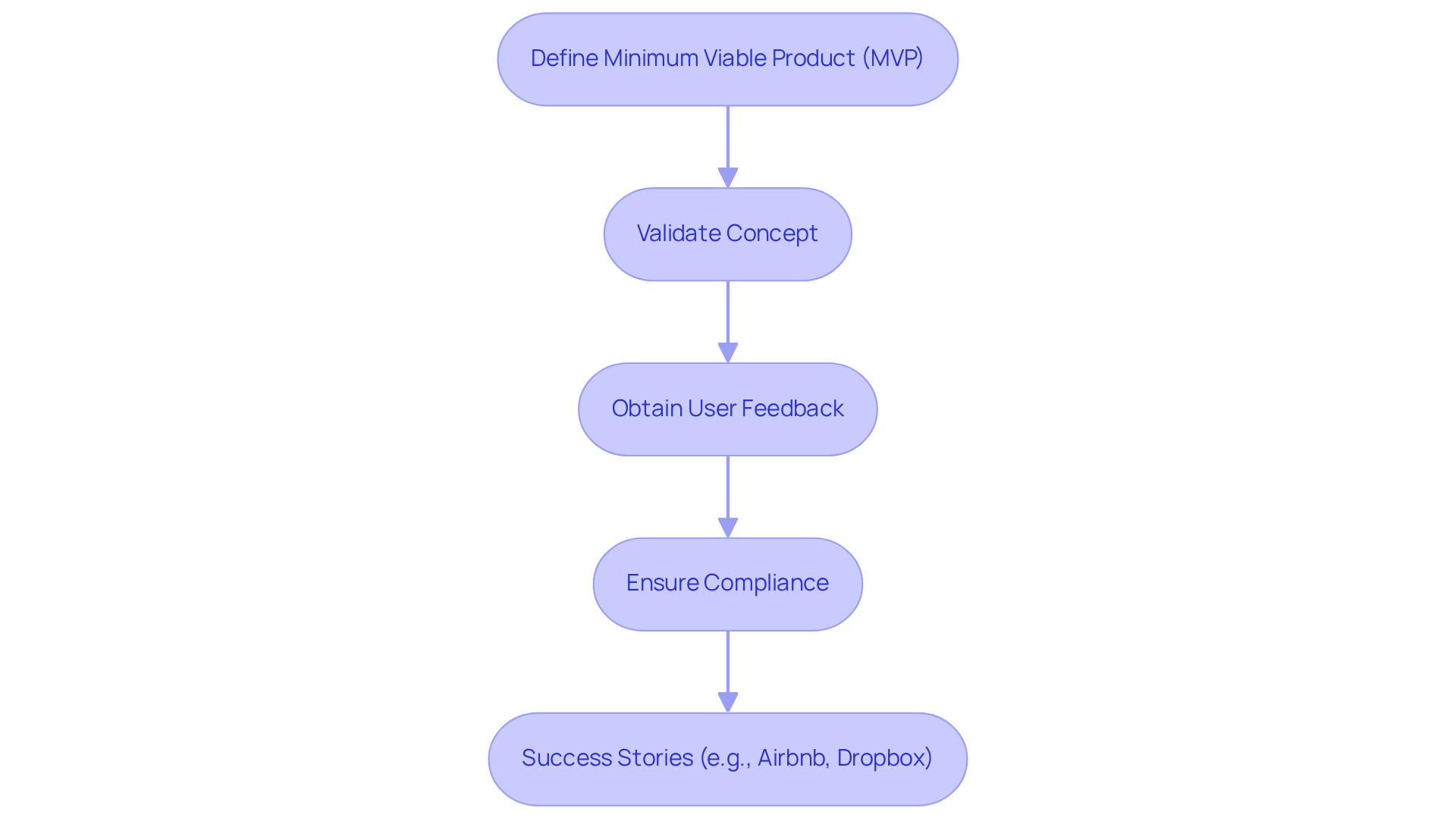
A Minimum Viable Offering (MVO) represents a streamlined version of a new creation, encompassing only the essential features needed to satisfy early adopters. To grasp what does MVP mean, one must recognize that the primary objective of an MVP is to validate a concept efficiently, utilizing minimal resources and time. By concentrating on core functionalities, businesses can obtain invaluable feedback from users, which subsequently informs further development. This strategic approach enables companies to test their hypotheses regarding customer needs and market demand before committing to full-scale production.
In the realm of digital offering development, proactively managing regulatory and compliance readiness is paramount when understanding what does MVP mean while crafting an MVP. Early attention to compliance requirements not only mitigates risks but also enhances the offering's market readiness. For instance, startups that incorporate compliance factors into their minimum viable offerings can avert costly changes in the future and ensure their creations align with industry standards from the outset.
Statistics indicate that approximately 72% of startups leverage the MVP approach, leading to the question of what does MVP mean, to refine their products based on user feedback, significantly boosting their prospects for long-term success. Industry leaders underscore the importance of minimum viable products, often asking what does MVP mean; companies that launch swiftly with an MVP gain a competitive edge, with 80% reporting faster adoption rates compared to their competitors. Noteworthy examples of successful minimum viable products include Airbnb, which initially validated its concept by renting out air mattresses, and Dropbox, which gauged interest through a simple explainer video that garnered 75,000 sign-ups overnight. These cases illustrate how minimum viable products can effectively validate product concepts and align offerings with market needs, ultimately fostering sustainable growth.
Trace the Origins and Evolution of MVPs
The concept of Minimum Viable Product (MVP), which answers what does MVP mean, was first introduced by Frank Robinson in 2001 and gained prominence through Eric Ries's influential book, 'The Lean Startup.' Initially, understanding what does MVP mean helped startups use minimum viable products as a strategic tool to validate their business ideas with minimal investment and risk. Over time, the MVP approach has evolved significantly, prompting many to wonder what does MVP mean in terms of incorporating agile methodologies and user-centered design principles. This evolution has allowed both startups and established firms to utilize minimum viable products, and when discussing this concept, many ask what does MVP mean as a means to innovate and adapt swiftly to market dynamics.
Statistics reveal that 82% of startups in North America actively implement MVP strategies, prompting an inquiry into what does MVP mean, and reflecting a robust trend towards rapid experimentation and validated learning. Furthermore, established firms have acknowledged what does MVP mean, recognizing the importance of minimal viable products and embracing this strategy to enhance their development procedures. For instance, a Californian startup successfully increased its annual revenue from $1 million to $20 million within two years by employing MVP principles, leading to discussions about what does MVP mean. This shift underscores a broader understanding of what does MVP mean, particularly in relation to the critical role customer feedback plays in shaping successful products, ultimately driving business growth and operational efficiency.

Identify Key Characteristics of Effective MVPs
Effective MVPs exhibit several key characteristics that help clarify what does MVP mean for success.
These characteristics collectively empower an MVP to effectively validate assumptions and inform subsequent development strategies, leading us to consider what does MVP mean.

Explore the Significance and Benefits of MVPs
The importance of key players lies in their capacity to minimize risk and improve learning during the development process. By launching a simplified version of a product, businesses can validate ideas, save resources, accelerate time to market, foster customer relationships, and iterate based on feedback.
Overall, the most valuable players represent a strategic approach that empowers businesses to innovate effectively while managing risk. Successful companies like Dropbox and Airbnb exemplify the power of MVPs, which helps explain what does mvp mean by allowing them to validate their concepts and achieve significant market success. For instance, Dropbox's explainer video MVP attracted 75,000 sign-ups overnight, showcasing the effectiveness of this approach in captivating individuals. As noted by industry experts, a tested MVP is one of the strongest signals a startup can provide to investors, showcasing real user engagement and interest.

Conclusion
Understanding the concept of a Minimum Viable Product (MVP) is essential for businesses aiming to innovate and succeed in a competitive landscape. An MVP serves as a foundational tool that enables companies to test their ideas with minimal investment while gathering crucial feedback from early adopters. This approach not only validates concepts but also aligns products with market needs, ultimately driving sustainable growth.
Key insights throughout the article highlight:
The discussion emphasizes how leveraging MVP strategies can significantly enhance a startup's chances of survival and success. Notable examples, such as Airbnb and Dropbox, demonstrate the tangible benefits realized through MVP implementation, showcasing how these companies effectively validated their concepts and achieved rapid market traction.
In conclusion, embracing the MVP methodology is not merely a strategic option; it is a vital practice for any business seeking to innovate while minimizing risks. By prioritizing user feedback and concentrating on essential features, companies can cultivate stronger customer relationships and iterate their products to better meet market demands. The significance of understanding what MVP means in business cannot be overstated, as it lays the groundwork for effective product development and long-term success.
{"@context": "https://schema.org", "@type": "FAQPage", "mainEntity": [{"@type": "Question", "name": "What is a Minimum Viable Product (MVP)?", "acceptedAnswer": {"@type": "Answer", "text": "A Minimum Viable Product (MVP) is a streamlined version of a new creation that includes only the essential features needed to satisfy early adopters. Its primary objective is to validate a concept efficiently while using minimal resources and time."}}, {"@type": "Question", "name": "What is the purpose of creating an MVP?", "acceptedAnswer": {"@type": "Answer", "text": "The purpose of creating an MVP is to obtain invaluable feedback from users, which informs further development. It allows businesses to test their hypotheses about customer needs and market demand before committing to full-scale production."}}, {"@type": "Question", "name": "Why is regulatory and compliance readiness important when developing an MVP?", "acceptedAnswer": {"@type": "Answer", "text": "Proactively managing regulatory and compliance readiness is crucial as it mitigates risks and enhances market readiness. By incorporating compliance factors into their MVPs, startups can avoid costly changes in the future and ensure alignment with industry standards from the outset."}}, {"@type": "Question", "name": "How prevalent is the MVP approach among startups?", "acceptedAnswer": {"@type": "Answer", "text": "Approximately 72% of startups leverage the MVP approach to refine their products based on user feedback, which significantly boosts their prospects for long-term success."}}, {"@type": "Question", "name": "What advantages do companies gain by launching with an MVP?", "acceptedAnswer": {"@type": "Answer", "text": "Companies that launch swiftly with an MVP gain a competitive edge, with 80% reporting faster adoption rates compared to their competitors."}}, {"@type": "Question", "name": "Can you provide examples of successful MVPs?", "acceptedAnswer": {"@type": "Answer", "text": "Noteworthy examples of successful MVPs include Airbnb, which initially validated its concept by renting out air mattresses, and Dropbox, which gauged interest through a simple explainer video that garnered 75,000 sign-ups overnight. These cases illustrate how MVPs can effectively validate product concepts and align offerings with market needs."}}]}{"@context": "https://schema.org", "@type": "BlogPosting", "headline": "What Does MVP Mean? Understanding Its Definition and Importance", "description": "Explore what MVP means and its significance in validating ideas and enhancing product development.", "datePublished": "2025-07-02T00:00:05.470000", "image": ["https://cdn.prod.website-files.com/5fc90bae06ffc6ed06fd0e3c/68647b906fef8456d18a7cec_pdqumqai-follow-the-arrows-to-see-how-defining-an-mvp-leads-to-validating-ideas-gathering-feedback-ensuring-compliance-and-learning-from-successful-examples.webp", "https://cdn.prod.website-files.com/5fc90bae06ffc6ed06fd0e3c/68647b906fef8456d18a7cf2_twgjsbzf-the-center-starts-with-the-concept-of-mvp-branching-into-its-history-importance-statistics-of-usage-and-practical-examples-each-branch-represents-an-aspect-that-contributes-to-understanding-how-mvp-has-shaped-business-strategies.webp", "https://cdn.prod.website-files.com/5fc90bae06ffc6ed06fd0e3c/68647b906fef8456d18a7ce9_zmngcrna-the-central-node-represents-the-concept-of-effective-mv-ps-while-each-branch-highlights-a-key-characteristic-that-contributes-to-its-success-this-layout-helps-to-clearly-see-how-these-characteristics-relate-to-the-main-idea.webp", "https://cdn.prod.website-files.com/5fc90bae06ffc6ed06fd0e3c/68647b906fef8456d18a7cef_gvfznsrf-the-central-node-represents-the-main-topic-of-mvp-benefits-each-branch-highlights-a-specific-advantage-providing-insights-and-statistics-that-illustrate-why-mv-ps-are-crucial-for-startups.webp"], "articleBody": "## Overview\nThe term MVP, or Minimum Viable Product, denotes a streamlined version of a product that encompasses only the essential features required to satisfy early adopters and validate a business concept with minimal resources. This approach is pivotal for businesses aiming to gather valuable user feedback, mitigate financial risks, and swiftly adapt their offerings to meet market demands. Consequently, leveraging an MVP significantly enhances the likelihood of achieving long-term success. By focusing on core functionalities, companies can not only test their hypotheses but also refine their products based on real user insights, ultimately fostering a more robust market presence.\n\n## Introduction\nUnderstanding the concept of a Minimum Viable Product (MVP) is crucial for startups and established businesses alike, as it serves as a foundational strategy in product development. By concentrating on essential features that meet the needs of early adopters, organizations can validate their ideas while minimizing risk and resource expenditure. \n\nHowever, as the landscape of product development evolves, a pressing question emerges: how can businesses effectively leverage MVPs not only to test their hypotheses but also to ensure compliance and foster long-term growth? \n\nThis exploration delves into the definition, significance, and key characteristics of MVPs, revealing insights that could transform the way companies approach innovation in a competitive marketplace.\n\n## Define Minimum Viable Product (MVP)\nA Minimum Viable Offering (MVO) represents a streamlined version of a new creation, encompassing only the essential features needed to satisfy early adopters. To grasp [what does MVP mean](https://valuespost.com/2024/11/mvp), one must recognize that the primary objective of an MVP is to validate a concept efficiently, utilizing minimal resources and time. By concentrating on core functionalities, businesses can obtain invaluable feedback from users, which subsequently informs further development. This strategic approach enables companies to test their hypotheses regarding customer needs and market demand before committing to full-scale production. \n\nIn the realm of digital offering development, proactively managing regulatory and compliance readiness is paramount when understanding what does MVP mean while crafting an MVP. Early attention to compliance requirements not only mitigates risks but also enhances the offering's market readiness. For instance, startups that incorporate compliance factors into their minimum viable offerings can avert costly changes in the future and ensure their creations align with industry standards from the outset. \n\nStatistics indicate that approximately 72% of startups leverage the MVP approach, leading to the question of what does MVP mean, to refine their products based on user feedback, significantly boosting their prospects for long-term success. Industry leaders underscore the importance of minimum viable products, often asking what does MVP mean; companies that launch swiftly with an MVP gain a competitive edge, with 80% reporting faster adoption rates compared to their competitors. Noteworthy examples of successful minimum viable products include Airbnb, which initially validated its concept by renting out air mattresses, and Dropbox, which gauged interest through a simple explainer video that garnered 75,000 sign-ups overnight. These cases illustrate how minimum viable products can effectively validate product concepts and align offerings with market needs, ultimately fostering sustainable growth.\n\n\n## Trace the Origins and Evolution of MVPs\nThe concept of Minimum Viable Product (MVP), which answers what does MVP mean, was first introduced by Frank Robinson in 2001 and gained prominence through Eric Ries's influential book, 'The Lean Startup.' Initially, understanding what does MVP mean helped startups use minimum viable products as a strategic tool to validate their business ideas with minimal investment and risk. Over time, the MVP approach has evolved significantly, prompting many to wonder what does MVP mean in terms of incorporating agile methodologies and user-centered design principles. This evolution has allowed both startups and established firms to utilize minimum viable products, and when discussing this concept, many ask what does MVP mean as a means to innovate and adapt swiftly to market dynamics. \n\nStatistics reveal that 82% of startups in North America actively implement MVP strategies, prompting an inquiry into what does MVP mean, and reflecting a robust trend towards rapid experimentation and validated learning. Furthermore, established firms have acknowledged what does MVP mean, recognizing the importance of minimal viable products and embracing this strategy to enhance their development procedures. For instance, a Californian startup successfully increased its annual revenue from $1 million to $20 million within two years by employing MVP principles, leading to discussions about what does MVP mean. This shift underscores a broader understanding of what does MVP mean, particularly in relation to the critical role [customer feedback](https://valuespost.com/2024/11/mvp) plays in shaping successful products, ultimately driving business growth and operational efficiency.\n\n\n## Identify Key Characteristics of Effective MVPs\nEffective MVPs exhibit several key characteristics that help clarify what does MVP mean for success. \n\n- **Core Functionality** is paramount; an MVP must focus on the vital features that address specific issues faced by users. \n- Furthermore, **Simplicity** in design is crucial, allowing users to easily understand and interact with the product. \n- The **Testability** of an MVP is another critical aspect; it should be designed to facilitate straightforward testing and the collection of user feedback. \n- Additionally, while an MVP is inherently basic, it must also possess **Scalability**, enabling future enhancements based on insights gained from user interactions. \n- Finally, a **User-Centric** approach is fundamental; the development process must prioritize user needs and experiences, ensuring that the MVP resonates with its intended audience. \n\nThese characteristics collectively empower an MVP to effectively [validate assumptions](https://goodfirms.co/resources/mvp-advantage-business-success) and inform subsequent development strategies, leading us to consider what does MVP mean.\n\n\n## Explore the Significance and Benefits of MVPs\nThe importance of key players lies in their capacity to minimize risk and improve learning during the development process. By launching a simplified version of a product, businesses can validate ideas, save resources, accelerate time to market, foster customer relationships, and iterate based on feedback. \n\n- **Validate Ideas**: Minimum Viable Products (MVPs) allow companies to test their product hypotheses in real market conditions, gathering feedback that can confirm or refute their assumptions, which leads to a better understanding of what does mvp mean. Startups that utilize MVPs to validate their ideas are 20% more likely to survive their first five years, which raises the question: what does mvp mean for their success compared to those that do not. Moreover, 42% of startups fail because they build something no one wants, which emphasizes the importance of understanding what does mvp mean for validating market demand. \n\n- **Save Resources**: Creating an MVP demands considerably fewer resources than a fully-equipped offering, with expenses generally varying from 50% to 70% lower. This approach minimizes financial risk, allowing startups to allocate their budgets more effectively. \n\n- **Accelerate Time to Market**: By concentrating on essential functionalities, businesses can introduce their offerings more quickly, gaining a competitive advantage. Companies that embrace the MVP strategy can cut their time-to-market by over fifty percent, which raises the question of what does mvp mean in terms of enabling faster feedback from consumers and quicker market entry. Notably, MVP-led SaaS startups can speed up acquisition by as much as 30%. \n\n- **Foster Customer Relationships**: Engaging early adopters through MVPs helps build connections and loyalty, as customers feel involved in the development process. This involvement can result in a 30% rise in retention rates, as items that integrate audience feedback during initial phases connect more effectively with their demographic. \n\n- **Iterate Based on Feedback**: The insights gained from MVP testing allow companies to enhance their offerings, ensuring that the final version closely aligns with consumer needs. This iterative process is crucial, as 91.3% of businesses that have launched a product using the MVP approach report its [effectiveness in meeting customer expectations](https://valuespost.com/2024/11/mvp). Furthermore, 65% of companies utilize user feedback from MVPs to prioritize feature development, highlighting the significance of ongoing enhancement. \n\nOverall, the most valuable players represent a strategic approach that empowers businesses to innovate effectively while managing risk. Successful companies like Dropbox and Airbnb exemplify the power of MVPs, which helps explain what does mvp mean by allowing them to validate their concepts and achieve significant market success. For instance, Dropbox's explainer video MVP attracted 75,000 sign-ups overnight, showcasing the effectiveness of this approach in captivating individuals. As noted by industry experts, a tested MVP is one of the strongest signals a startup can provide to investors, showcasing real user engagement and interest.\n\n\n\n## Conclusion\nUnderstanding the concept of a Minimum Viable Product (MVP) is essential for businesses aiming to innovate and succeed in a competitive landscape. An MVP serves as a foundational tool that enables companies to test their ideas with minimal investment while gathering crucial feedback from early adopters. This approach not only validates concepts but also aligns products with market needs, ultimately driving sustainable growth. \n\nKey insights throughout the article highlight: \n1. The importance of focusing on core functionalities \n2. The necessity of regulatory compliance \n3. The characteristics that define effective MVPs \n\nThe discussion emphasizes how leveraging MVP strategies can significantly enhance a startup's chances of survival and success. Notable examples, such as Airbnb and Dropbox, demonstrate the tangible benefits realized through MVP implementation, showcasing how these companies effectively validated their concepts and achieved rapid market traction. \n\nIn conclusion, embracing the MVP methodology is not merely a strategic option; it is a vital practice for any business seeking to innovate while minimizing risks. By prioritizing user feedback and concentrating on essential features, companies can cultivate stronger customer relationships and iterate their products to better meet market demands. The significance of understanding what MVP means in business cannot be overstated, as it lays the groundwork for effective product development and long-term success.\n\n::iframe[https://iframe.tely.ai/cta/eyJhcnRpY2xlX2lkIjogIjY4NjQ3Njg1MzhlNTI4YTlhZTYxMDVjNyIsICJjb21wYW55X2lkIjogIjY3YzVkZmRhMjY3MzljNjRhMWVjYjdiYSIsICJpbmRleCI6IG51bGwsICJ0eXBlIjogImFydGljbGUifQ==]{width=\"100%\" height=\"300px\"}"}