
AI
Insights
Master Web Apps Development: Best Practices for CTOs

Overview
The article titled "Master Web Apps Development: Best Practices for CTOs" primarily focuses on outlining essential practices and strategies for Chief Technology Officers (CTOs) to effectively manage web application development.
Understanding the unique characteristics of web applications is crucial; it forms the foundation for implementing a structured development process.
Furthermore, planning for maintenance and continuous improvement is vital, as these elements are critical for ensuring successful and efficient web solutions in a competitive landscape.
By adhering to these best practices, CTOs can navigate the complexities of web app development with confidence and precision.
Introduction
In a world increasingly reliant on digital solutions, web applications have emerged as pivotal tools for businesses aiming to enhance user engagement and streamline operations. These dynamic platforms not only facilitate real-time interactions but also provide valuable insights that drive data-informed decision-making. However, as the landscape of web app development evolves, CTOs face the pressing challenge of navigating complex technologies and methodologies to ensure their applications meet user expectations.
What best practices can these leaders adopt to master web app development and overcome the hurdles that lie ahead?
Define Web Applications and Their Importance
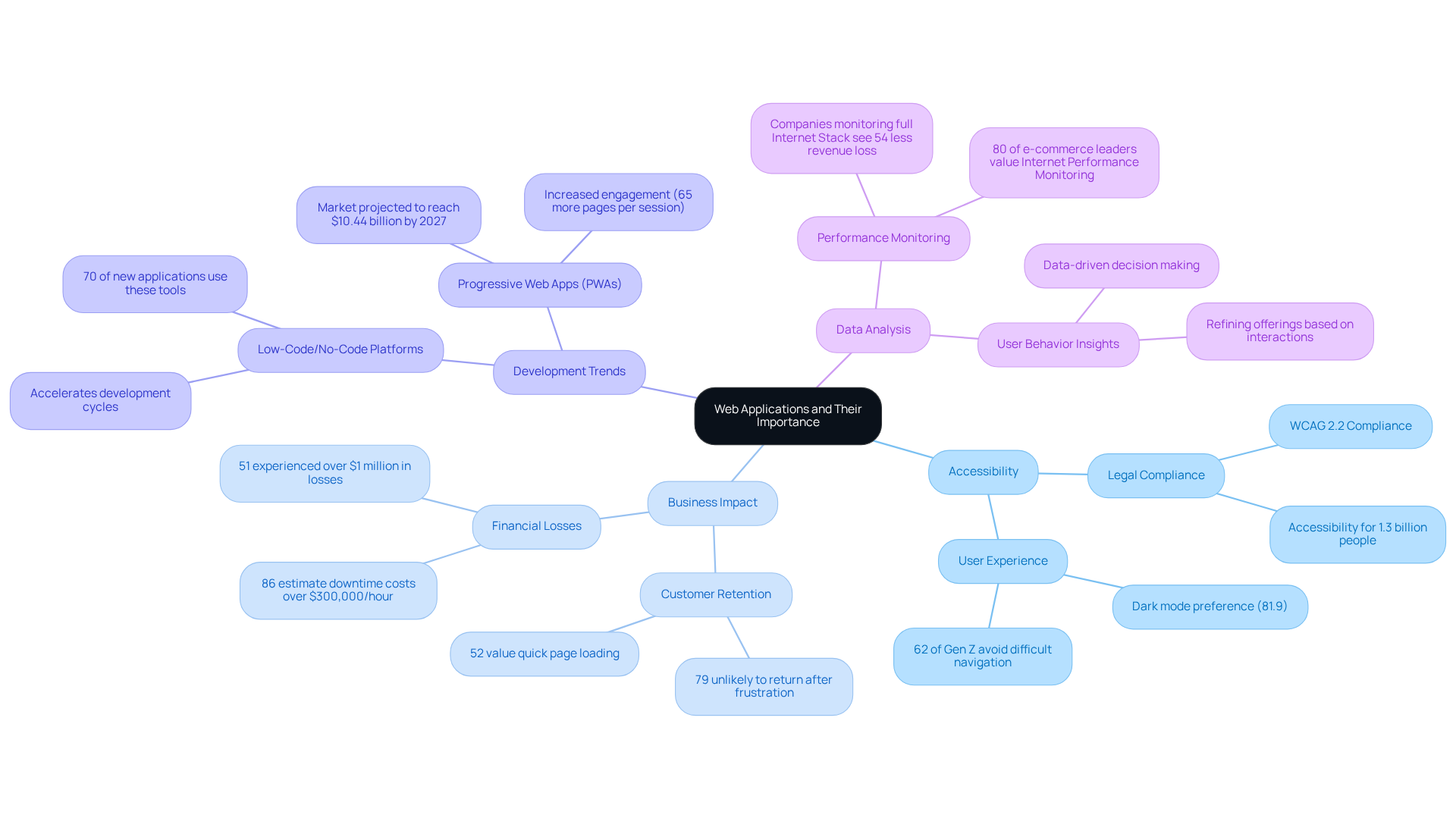
Web programs represent dynamic software solutions that are hosted on web servers and accessed through web browsers, thus eliminating the need for local installation. This accessibility is crucial, as it allows users to interact with applications from any device with internet connectivity. Their significance extends beyond mere convenience; web platforms are designed to deliver seamless experiences, enabling real-time data processing and integration with various services and APIs.
The impact of online tools on business expansion is profound. They enhance engagement by providing interactive features that keep users invested in the platform. For example, research shows that 79% of online shoppers who face a frustrating experience are unlikely to return, highlighting the necessity for intuitive design and performance. Additionally, businesses leveraging online platforms can streamline operations, leading to increased efficiency and reduced costs. Notably, 80% of e-commerce leaders believe that investing in Internet Performance Monitoring significantly enhances customer experience, which is vital for retaining clients in a competitive landscape.
Current trends in web apps development indicate a shift towards low-code and no-code platforms, with 70% of new applications being developed using these tools. This trend not only accelerates the cycles of web apps development but also democratizes the creation of web platforms, allowing non-technical individuals to engage in the process. Moreover, the growing emphasis on accessibility ensures that web platforms cater to a diverse audience, making adherence to standards such as WCAG increasingly important.
In terms of data analysis, online platforms provide businesses with valuable insights into user behavior and preferences, facilitating data-driven decision-making. By examining user interactions, companies can refine their offerings and improve overall user satisfaction. As the web development market continues to evolve, the integration of advanced analytics within web solutions will be essential for shaping business strategies and driving growth.
Differentiate Web Apps from Websites and Mobile Apps
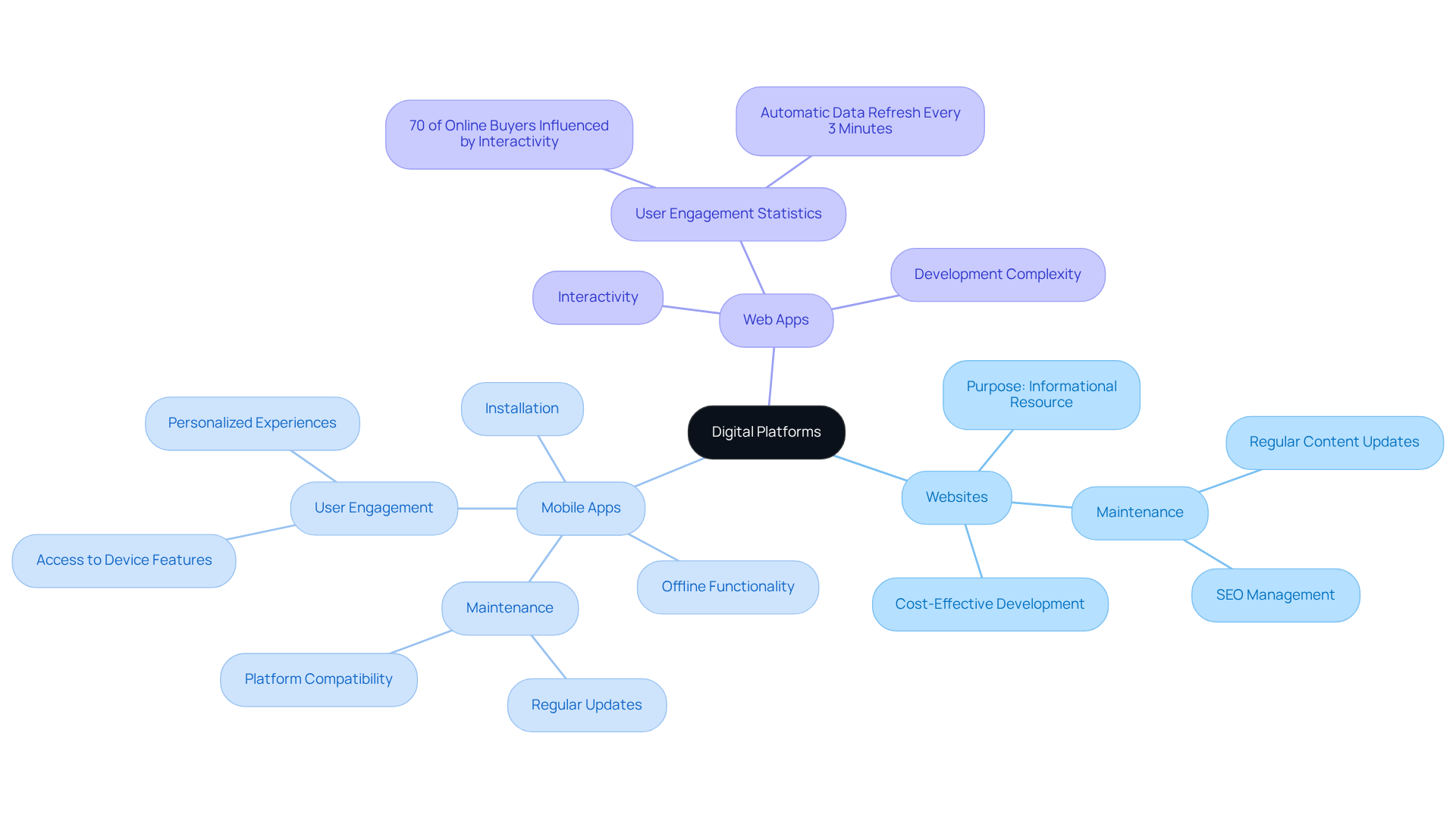
Web platforms, websites, and mobile software each serve distinct purposes and functionalities. Websites primarily function as informational resources, providing content to visitors without significant interaction. Conversely, mobile apps are specifically designed for mobile devices, often necessitating installation and offering offline functionalities that enhance user engagement.
Ongoing maintenance for mobile apps involves:
Web apps development creates dynamic and interactive web applications that allow users to perform tasks and engage with content in real-time. For instance, research indicates that 70% of online buyers are influenced by interactive features in their purchasing decisions, underscoring the importance of audience engagement in digital solutions.
Understanding these distinctions empowers CTOs to make informed choices about the appropriate platform for their projects, aligning with client expectations and business objectives. As we approach 2025, the choice between these platforms will increasingly hinge on:
Enterprises prioritizing client interaction may find web apps development through online solutions to be more beneficial, particularly as emerging trends like serverless architecture and low-code platforms simplify development processes. Furthermore, it is essential to recognize that websites can typically be developed at significantly lower costs than mobile apps, making financial considerations a pivotal factor in decision-making.
Explore Types of Web Applications: Dynamic, Single Page, and Progressive
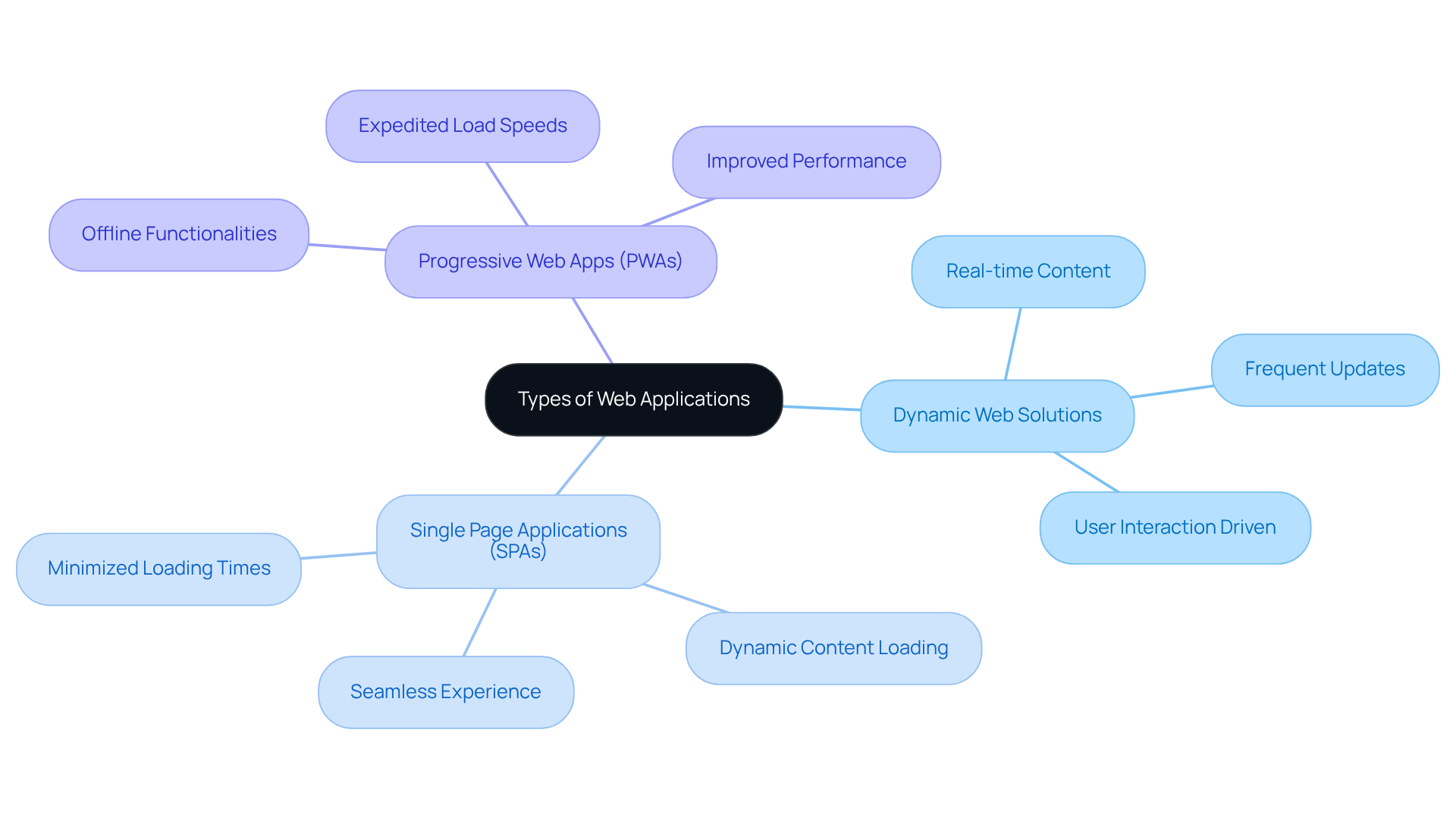
Web platforms can be classified into various categories, each providing unique characteristics designed for particular needs. Dynamic web solutions are crafted to generate content in real-time based on user interactions, rendering them especially suitable for platforms requiring frequent updates, such as news sites or social media. Conversely, Single Page Applications (SPAs) load a single HTML page and dynamically refresh content as users interact, resulting in a seamless and responsive experience. This methodology minimizes loading times and enhances engagement, which is crucial in today’s fast-paced digital landscape.
Progressive Web Apps (PWAs) embody a hybrid model that merges the advantages of web and mobile platforms. They provide offline functionalities, expedited load speeds, and improved performance, making them an attractive choice for businesses striving to enhance user experience without sacrificing accessibility.
As we approach 2025, the trend towards dynamic web solutions continues to escalate, with statistics revealing that over 70% of web traffic is driven by dynamic content. This shift underscores the importance of understanding these software types, enabling CTOs to align their development strategies with user expectations and emerging technological capabilities. By harnessing the strengths of dynamic, single-page, and progressive web apps development, organizations can forge more engaging and effective digital solutions. Furthermore, challenges such as the lack of 'out-of-the-box' solutions in frameworks like Flutter can hinder progress, highlighting the necessity for CTOs to identify potential pitfalls in their strategies.
Identify Essential Technologies for Web App Development
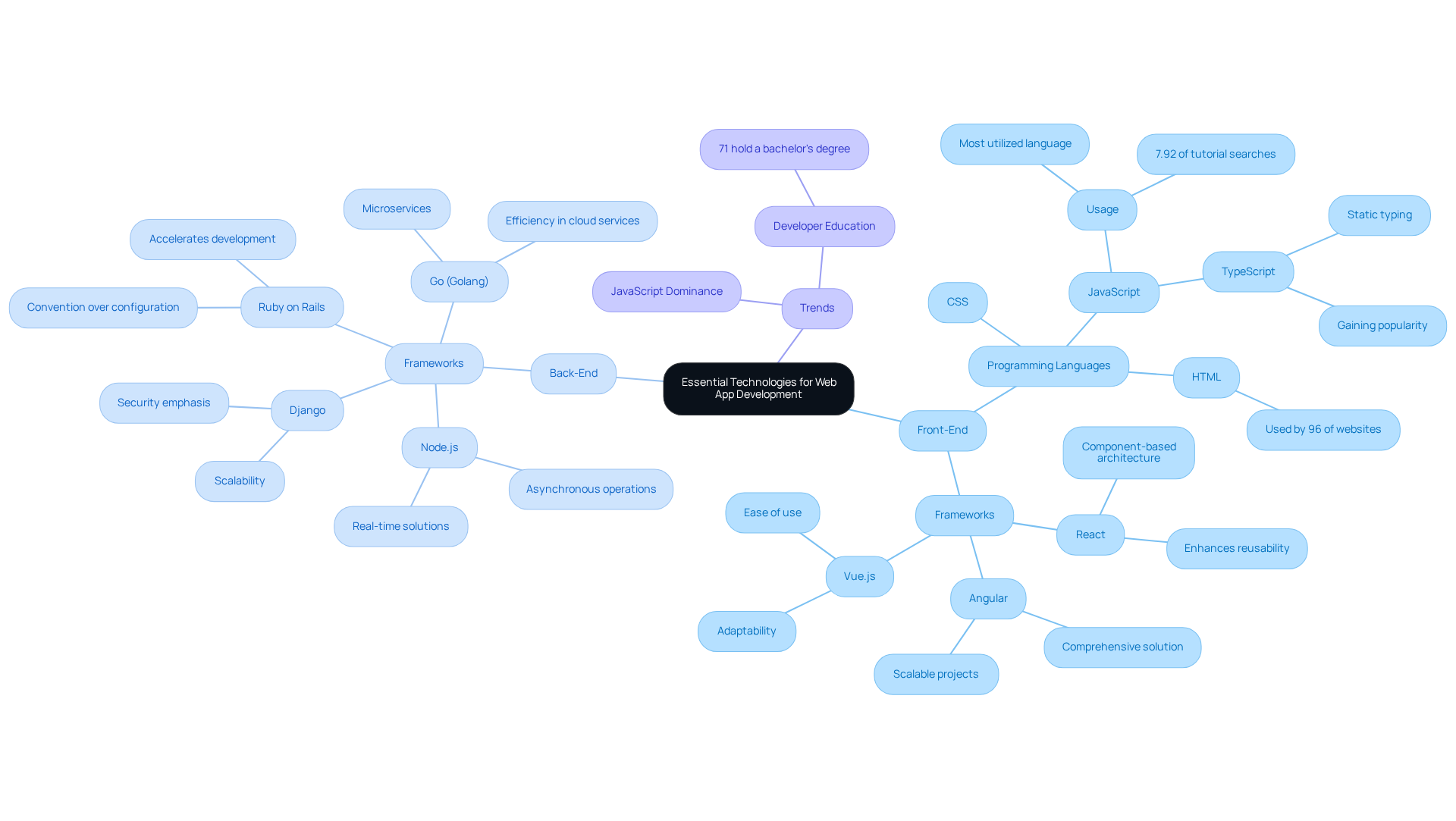
The success of web apps development hinges on a robust selection of technologies. Key programming languages encompass JavaScript, HTML, and CSS, which form the backbone of front-end development. Frameworks such as React, Angular, and Vue.js are instrumental in crafting dynamic user interfaces. React is particularly favored for its component-based architecture, which enhances reusability and performance. Angular provides a comprehensive solution for developing scalable projects, while Vue.js is praised for its ease of use and adaptability, making it a preferred choice among developers. Moreover, PHP remains a crucial element in web creation, utilized by 75% of all websites due to its simplicity and strong community support.
On the back end, Node.js, Ruby on Rails, and Django emerge as preferred frameworks. Node.js excels in managing asynchronous operations, making it ideal for real-time solutions. Ruby on Rails is recognized for its convention-over-configuration methodology, which accelerates development time. Django, with its emphasis on security and scalability, stands out as a robust option for creating resilient web solutions. Additionally, Go (Golang) is gaining traction for its efficiency in cloud services and microservices, positioning it as a relevant choice for modern web applications.
As we look toward 2025, the landscape of programming languages continues to evolve. JavaScript retains its dominance, closely followed by Python, which has surged in popularity due to its extensive libraries and frameworks tailored for web development. Furthermore, languages like TypeScript are gaining prominence for their ability to catch errors early through static typing, thereby enhancing code quality. SQL is actively employed by 54% of developers, underscoring its importance in data management within web systems.
Statistics reveal that JavaScript remains the most utilized language, with over 7.92% of programming language tutorial searches dedicated to it. Meanwhile, HTML is employed by more than 96% of websites globally, highlighting its foundational role in web development.
To further enhance scalability and performance in web apps development, it is essential to leverage cloud services such as AWS or Azure. These platforms provide the infrastructure necessary for deploying applications efficiently and managing resources effectively. Moreover, integrating AI technologies can significantly boost user engagement and operational efficiency, making it imperative for CTOs to stay informed about the latest advancements in the tech landscape. Additionally, understanding the educational background of web developers, with 71% holding a bachelor's degree, provides context on the expertise available in the field. Ultimately, CTOs must recognize common pitfalls in web apps development, such as the cost implications of rectifying mistakes post-completion, which can be considerably greater than addressing them during the web apps development phase.
Implement a Step-by-Step Web Application Development Process
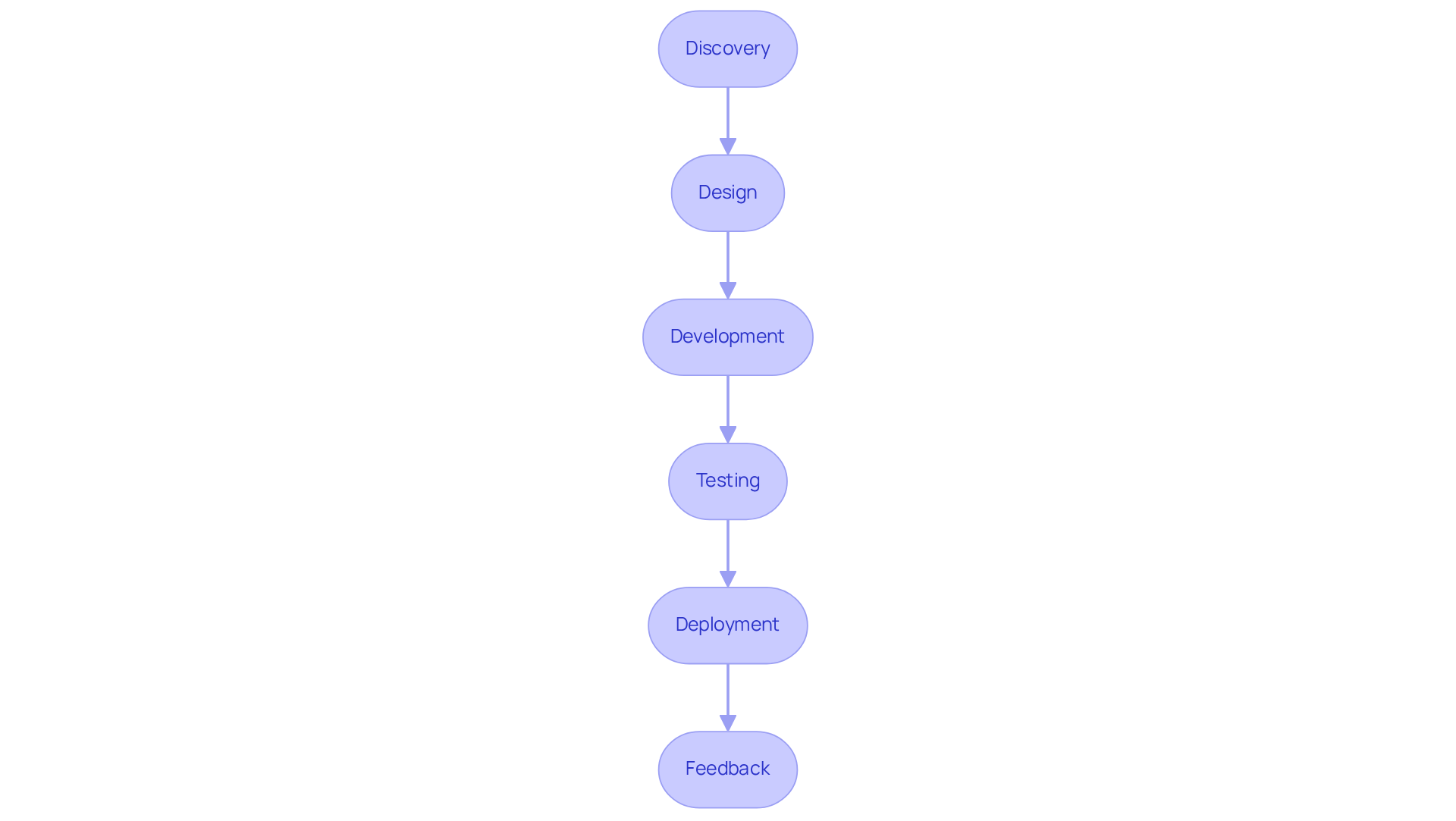
Implementing a structured web apps development process is essential for success in 2025. This process encompasses several key stages:
Following this organized method not only aligns the final product with client expectations but also supports overall business objectives, fostering long-term success. Statistics show that the development of web apps is significantly more cost-efficient than traditional mobile apps, making this structured approach even more vital. As highlighted by industry specialists, 'Feedback and iteration constitute a vital component of web apps development,' underscoring the significance of user input in enhancing applications. Successful case studies, such as Mindbowser's timely project delivery and the transformation of a SaaS platform, illustrate the effectiveness of this structured process. Furthermore, CTOs should be aware of common pitfalls, such as neglecting the importance of a comprehensive project plan and the right technology stack, to avoid missteps in their development journey.
Plan for Maintenance and Continuous Improvement
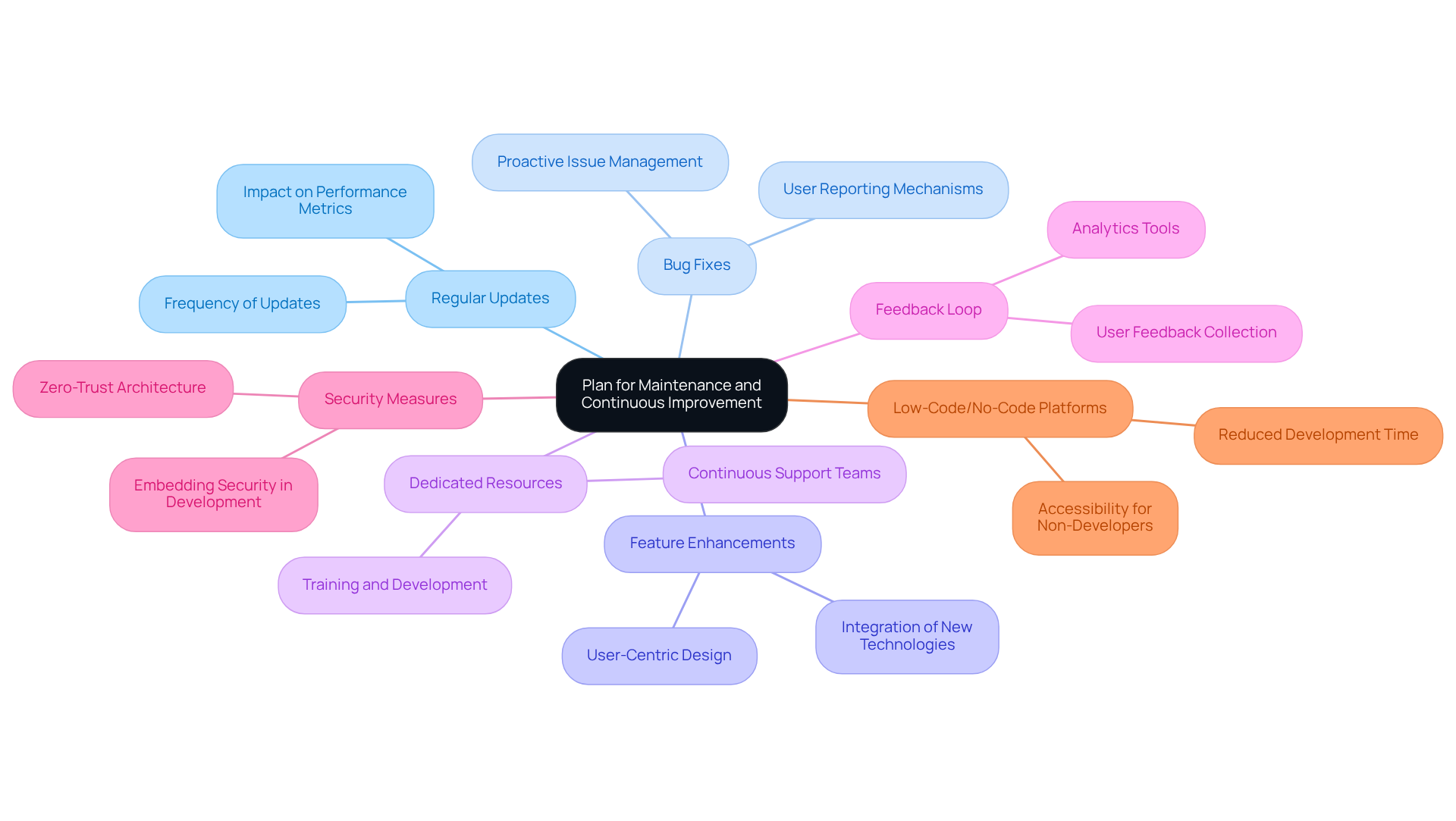
Effective planning for maintenance and continuous improvement is essential for web platforms in 2025. CTOs must develop a robust strategy that encompasses:
Furthermore, assigning dedicated resources for continuous support is crucial, as is creating a feedback loop with users to identify areas requiring enhancement. Utilizing analytics tools can provide valuable insights into consumer behavior, guiding future enhancements and ensuring that software evolves in line with expectations.
Focusing on maintenance not only enhances performance but also keeps web solutions competitive in a swiftly evolving digital environment. Frequent updates can significantly impact performance metrics; for instance, research indicates that software undergoing regular improvements sees a notable rise in satisfaction and engagement.
Moreover, low-code and no-code platforms are proven to decrease development time and expenses. By adopting these strategies, including the integration of security measures into the maintenance plan, CTOs can cultivate a culture of continuous improvement, ensuring their web applications remain relevant and effective in meeting user needs.
Conclusion
Web applications are pivotal in today's digital landscape, serving as dynamic software solutions that enhance accessibility and user engagement across various devices. Their ability to provide real-time interaction and integration with multiple services underscores their importance for businesses aiming to thrive in a competitive environment. As organizations increasingly prioritize web apps over traditional platforms, understanding their unique benefits and development strategies becomes essential for CTOs.
Key insights discussed highlight the distinctions between web apps, websites, and mobile applications, emphasizing the growing trend towards dynamic, single-page, and progressive web apps. The article outlines essential technologies and a structured development process, reinforcing the need for careful planning and execution to avoid common pitfalls. Furthermore, the significance of ongoing maintenance and continuous improvement is underscored, as regular updates and user feedback are crucial for enhancing performance and satisfaction.
In conclusion, as the digital landscape evolves, CTOs must remain proactive in adopting best practices for web app development. Embracing low-code and no-code platforms, leveraging advanced technologies, and fostering a culture of continuous improvement will not only enhance user experiences but also drive business growth. The future of web applications is bright; by prioritizing strategic development and maintenance, organizations can ensure their solutions remain relevant and impactful in meeting user needs.
{"@context": "https://schema.org", "@type": "FAQPage", "mainEntity": [{"@type": "Question", "name": "What are web applications and why are they important?", "acceptedAnswer": {"@type": "Answer", "text": "Web applications are dynamic software solutions hosted on web servers and accessed through web browsers. They are important because they allow users to interact with applications from any device with internet access, providing seamless experiences and enabling real-time data processing and integration with various services."}}, {"@type": "Question", "name": "How do web applications impact business expansion?", "acceptedAnswer": {"@type": "Answer", "text": "Web applications enhance user engagement through interactive features, which is crucial for retaining customers. They streamline operations, increase efficiency, and reduce costs. Research shows that 80% of e-commerce leaders believe that investing in Internet Performance Monitoring improves customer experience, which is vital for client retention."}}, {"@type": "Question", "name": "What are the current trends in web app development?", "acceptedAnswer": {"@type": "Answer", "text": "Current trends indicate a shift towards low-code and no-code platforms, with 70% of new applications being developed using these tools. This trend accelerates development cycles and allows non-technical individuals to participate in creating web platforms. There is also a growing emphasis on accessibility to cater to a diverse audience."}}, {"@type": "Question", "name": "How do web applications differ from websites and mobile apps?", "acceptedAnswer": {"@type": "Answer", "text": "Websites primarily serve as informational resources with minimal interaction, while mobile apps are designed for mobile devices, requiring installation and often providing offline functionalities. Web applications, on the other hand, are dynamic and interactive, allowing users to perform tasks in real-time."}}, {"@type": "Question", "name": "What factors should CTOs consider when choosing between web apps, websites, and mobile apps?", "acceptedAnswer": {"@type": "Answer", "text": "CTOs should consider the desired level of interactivity, audience requirements, and the complexity of the content. As we approach 2025, the decision will increasingly depend on these factors, with web apps often being more beneficial for client interaction."}}, {"@type": "Question", "name": "What are the maintenance requirements for mobile apps?", "acceptedAnswer": {"@type": "Answer", "text": "Ongoing maintenance for mobile apps includes regular updates and ensuring compatibility across platforms, which is a critical consideration for CTOs."}}, {"@type": "Question", "name": "Why might websites be a more cost-effective option than mobile apps?", "acceptedAnswer": {"@type": "Answer", "text": "Websites can typically be developed at significantly lower costs than mobile apps, making financial considerations a pivotal factor in the decision-making process for businesses."}}]}{"@context": "https://schema.org", "@type": "BlogPosting", "headline": "Master Web Apps Development: Best Practices for CTOs", "description": "Master best practices in web apps development to enhance user experience and drive business growth.", "datePublished": "2025-09-15T00:00:05.863000", "image": ["https://cdn.prod.website-files.com/5fc90bae06ffc6ed06fd0e3c/68c75e0f8e7f964737d23427_brctadbp-the-central-idea-is-web-applications-and-their-importance-with-branches-representing-key-themes-each-sub-node-provides-additional-detail-helping-you-understand-how-web-apps-influence-accessibility-business-growth-and-development-trends.webp", "https://cdn.prod.website-files.com/5fc90bae06ffc6ed06fd0e3c/68c75e0f8e7f964737d2342a_kjyptfga-the-central-node-represents-the-overall-topic-each-branch-shows-a-different-type-of-digital-platform-with-sub-branches-providing-more-details-about-their-functions-characteristics-and-considerations-the-colors-help-differentiate-between-the-platforms-for-easier-understanding.webp", "https://cdn.prod.website-files.com/5fc90bae06ffc6ed06fd0e3c/68c75e0f8e7f964737d2342d_ykidstky-the-central-node-shows-the-main-topic-while-the-branches-detail-each-type-of-web-application-follow-the-branches-to-understand-their-unique-features-and-how-they-enhance-user-experience.webp", "https://cdn.prod.website-files.com/5fc90bae06ffc6ed06fd0e3c/68c75e0f8e7f964737d23430_qrysqwwh-this-mindmap-starts-with-the-main-topic-in-the-center-branches-lead-to-categories-like-front-end-and-back-end-technologies-with-further-details-branching-out-the-color-coded-categories-help-differentiate-between-topics-and-make-the-information-easy-to-follow.webp", "https://cdn.prod.website-files.com/5fc90bae06ffc6ed06fd0e3c/68c75e0f8e7f964737d23433_vljlvfvh-each-box-represents-a-critical-step-in-developing-a-web-application-follow-the-arrows-to-see-how-each-stage-leads-to-the-next-emphasizing-the-importance-of-user-feedback-after-deployment.webp", "https://cdn.prod.website-files.com/5fc90bae06ffc6ed06fd0e3c/68c75e0f8e7f964737d23424_hvvteacl-start-at-the-center-with-the-main-plan-then-explore-the-branches-to-see-individual-strategies-and-how-they-support-ongoing-improvement-and-maintenance.webp"], "articleBody": "## Overview\nThe article titled \"Master Web Apps Development: Best Practices for CTOs\" primarily focuses on outlining essential practices and strategies for Chief Technology Officers (CTOs) to effectively manage web application development. \n\nUnderstanding the unique characteristics of web applications is crucial; it forms the foundation for implementing a structured development process. \n\nFurthermore, planning for maintenance and continuous improvement is vital, as these elements are critical for ensuring successful and efficient web solutions in a competitive landscape. \n\nBy adhering to these best practices, CTOs can navigate the complexities of web app development with confidence and precision.\n\n## Introduction\nIn a world increasingly reliant on digital solutions, web applications have emerged as pivotal tools for businesses aiming to enhance user engagement and streamline operations. These dynamic platforms not only facilitate real-time interactions but also provide valuable insights that drive data-informed decision-making. However, as the landscape of web app development evolves, CTOs face the pressing challenge of navigating complex technologies and methodologies to ensure their applications meet user expectations. \n\nWhat best practices can these leaders adopt to master web app development and overcome the hurdles that lie ahead?\n\n## Define Web Applications and Their Importance\nWeb programs represent [dynamic software solutions](https://studiographene.com) that are hosted on web servers and accessed through web browsers, thus eliminating the need for local installation. This accessibility is crucial, as it allows users to interact with applications from any device with internet connectivity. Their significance extends beyond mere convenience; web platforms are designed to deliver seamless experiences, enabling real-time data processing and integration with various services and APIs.\n\nThe impact of online tools on business expansion is profound. They enhance engagement by providing interactive features that keep users invested in the platform. For example, research shows that 79% of online shoppers who face a frustrating experience are unlikely to return, highlighting the necessity for intuitive design and performance. Additionally, businesses leveraging online platforms can streamline operations, leading to increased efficiency and reduced costs. Notably, 80% of e-commerce leaders believe that investing in Internet Performance Monitoring significantly enhances customer experience, which is vital for retaining clients in a competitive landscape.\n\nCurrent trends in web apps development indicate a shift towards low-code and no-code platforms, with 70% of new applications being developed using these tools. This trend not only accelerates the cycles of web apps development but also democratizes the creation of web platforms, allowing non-technical individuals to engage in the process. Moreover, the growing emphasis on accessibility ensures that web platforms cater to a diverse audience, making adherence to standards such as WCAG increasingly important.\n\nIn terms of data analysis, online platforms provide businesses with valuable insights into user behavior and preferences, facilitating data-driven decision-making. By examining user interactions, companies can refine their offerings and improve overall user satisfaction. As the web development market continues to evolve, the integration of advanced analytics within web solutions will be essential for shaping business strategies and driving growth.\n\n\n## Differentiate Web Apps from Websites and Mobile Apps\nWeb platforms, websites, and mobile software each serve distinct purposes and functionalities. Websites primarily function as [informational resources](https://brainiacmedia.net/blogs/understanding-mobile-app-vs-website-key-differences?srsltid=AfmBOooAm4KsOQMsSy2M50prQklgPq8J4inocNjaK4c3gaqUcGC-e6z2), providing content to visitors without significant interaction. Conversely, mobile apps are specifically designed for mobile devices, often necessitating installation and offering offline functionalities that enhance user engagement. \n\nOngoing maintenance for mobile apps involves:\n\n1. Regular updates\n2. Ensuring platform compatibility, a critical consideration for CTOs.\n\nWeb apps development creates dynamic and interactive web applications that allow users to perform tasks and engage with content in real-time. For instance, research indicates that 70% of online buyers are influenced by interactive features in their purchasing decisions, underscoring the importance of audience engagement in digital solutions. \n\nUnderstanding these distinctions empowers CTOs to make informed choices about the appropriate platform for their projects, aligning with client expectations and business objectives. As we approach 2025, the choice between these platforms will increasingly hinge on:\n\n1. The desired level of interactivity\n2. Audience requirements\n3. The complexity of the content being delivered.\n\nEnterprises prioritizing client interaction may find web apps development through online solutions to be more beneficial, particularly as emerging trends like serverless architecture and low-code platforms simplify development processes. Furthermore, it is essential to recognize that websites can typically be developed at significantly lower costs than mobile apps, making financial considerations a pivotal factor in decision-making.\n\n\n## Explore Types of Web Applications: Dynamic, Single Page, and Progressive\nWeb platforms can be classified into various categories, each providing [unique characteristics](https://studiographene.com/about) designed for particular needs. Dynamic web solutions are crafted to generate content in real-time based on user interactions, rendering them especially suitable for platforms requiring frequent updates, such as news sites or social media. Conversely, Single Page Applications (SPAs) load a single HTML page and dynamically refresh content as users interact, resulting in a seamless and responsive experience. This methodology minimizes loading times and enhances engagement, which is crucial in today\u2019s fast-paced digital landscape.\n\nProgressive Web Apps (PWAs) embody a hybrid model that merges the advantages of web and mobile platforms. They provide offline functionalities, expedited load speeds, and improved performance, making them an attractive choice for businesses striving to enhance user experience without sacrificing accessibility.\n\nAs we approach 2025, the trend towards dynamic web solutions continues to escalate, with statistics revealing that over 70% of web traffic is driven by dynamic content. This shift underscores the importance of understanding these software types, enabling CTOs to align their development strategies with user expectations and emerging technological capabilities. By harnessing the strengths of dynamic, single-page, and progressive web apps development, organizations can forge more engaging and effective digital solutions. Furthermore, challenges such as the lack of 'out-of-the-box' solutions in frameworks like Flutter can hinder progress, highlighting the necessity for CTOs to identify potential pitfalls in their strategies.\n\n\n## Identify Essential Technologies for Web App Development\nThe success of web apps development hinges on a robust selection of technologies. Key programming languages encompass JavaScript, HTML, and CSS, which form the backbone of front-end development. Frameworks such as React, Angular, and Vue.js are instrumental in crafting dynamic user interfaces. React is particularly favored for its component-based architecture, which enhances reusability and performance. Angular provides a comprehensive solution for developing scalable projects, while Vue.js is praised for its ease of use and adaptability, making it a preferred choice among developers. Moreover, PHP remains a crucial element in web creation, utilized by 75% of all websites due to its simplicity and strong community support.\n\nOn the back end, Node.js, Ruby on Rails, and Django emerge as preferred frameworks. Node.js excels in managing asynchronous operations, making it ideal for real-time solutions. Ruby on Rails is recognized for its convention-over-configuration methodology, which accelerates development time. Django, with its emphasis on security and scalability, stands out as a robust option for creating resilient web solutions. Additionally, Go (Golang) is gaining traction for its efficiency in cloud services and microservices, positioning it as a relevant choice for modern web applications.\n\nAs we look toward 2025, the landscape of programming languages continues to evolve. JavaScript retains its dominance, closely followed by Python, which has surged in popularity due to its extensive libraries and frameworks tailored for web development. Furthermore, languages like TypeScript are gaining prominence for their ability to catch errors early through static typing, thereby enhancing code quality. SQL is actively employed by 54% of developers, underscoring its importance in data management within web systems.\n\nStatistics reveal that JavaScript remains the most utilized language, with over 7.92% of programming language tutorial searches dedicated to it. Meanwhile, HTML is employed by more than 96% of websites globally, highlighting its foundational role in web development.\n\nTo further enhance scalability and performance in web apps development, it is essential to leverage cloud services such as AWS or Azure. These platforms provide the infrastructure necessary for deploying applications efficiently and managing resources effectively. Moreover, integrating AI technologies can significantly boost user engagement and operational efficiency, making it imperative for CTOs to stay informed about the latest advancements in the tech landscape. Additionally, understanding the educational background of web developers, with 71% holding a bachelor's degree, provides context on the expertise available in the field. Ultimately, CTOs must recognize common pitfalls in web apps development, such as the [cost implications of rectifying mistakes](https://digitalsilk.com/digital-trends/web-development-statistics) post-completion, which can be considerably greater than addressing them during the web apps development phase.\n\n\n## Implement a Step-by-Step Web Application Development Process\nImplementing a structured web apps development process is essential for success in 2025. This process encompasses several key stages:\n\n1. Discovery: Identify needs and market opportunities through thorough research, ensuring alignment with business objectives. \n2. Design: Create wireframes and prototypes to visualize the software, facilitating discussions about layout and user interaction. \n3. Development: Build the software using a carefully selected technology stack that meets both functional requirements and budget constraints. \n4. Testing: [Conduct rigorous testing](https://mindbowser.com/step-by-step-guide-on-web-application-development) to identify and rectify bugs, ensuring the software performs optimally. \n5. Deployment: Launch the application on a suitable hosting solution, whether cloud-based or self-hosted, to ensure accessibility for users. \n6. Feedback: Collect input from users to promote ongoing enhancement, as this information is vital for refining features and increasing satisfaction. \n\nFollowing this organized method not only aligns the final product with client expectations but also supports overall business objectives, fostering long-term success. Statistics show that the development of web apps is significantly more cost-efficient than traditional mobile apps, making this structured approach even more vital. As highlighted by industry specialists, 'Feedback and iteration constitute a vital component of web apps development,' underscoring the significance of user input in enhancing applications. Successful case studies, such as Mindbowser's timely project delivery and the transformation of a SaaS platform, illustrate the effectiveness of this structured process. Furthermore, CTOs should be aware of common pitfalls, such as neglecting the importance of a comprehensive project plan and the right technology stack, to avoid missteps in their development journey.\n\n\n## Plan for Maintenance and Continuous Improvement\nEffective planning for maintenance and continuous improvement is essential for web platforms in 2025. CTOs must develop a robust strategy that encompasses:\n\n1. Regular updates\n2. Bug fixes\n3. Feature enhancements\n\nFurthermore, assigning dedicated resources for continuous support is crucial, as is creating a feedback loop with users to identify areas requiring enhancement. Utilizing [analytics tools](https://directimpactsolutions.com/en/2025-web-application-development-trends-you-need-to-know) can provide valuable insights into consumer behavior, guiding future enhancements and ensuring that software evolves in line with expectations. \n\nFocusing on maintenance not only enhances performance but also keeps web solutions competitive in a swiftly evolving digital environment. Frequent updates can significantly impact performance metrics; for instance, research indicates that software undergoing regular improvements sees a notable rise in satisfaction and engagement. \n\nMoreover, low-code and no-code platforms are proven to decrease development time and expenses. By adopting these strategies, including the integration of security measures into the maintenance plan, CTOs can cultivate a culture of continuous improvement, ensuring their web applications remain relevant and effective in meeting user needs.\n\n\n\n## Conclusion\nWeb applications are pivotal in today's digital landscape, serving as dynamic software solutions that enhance accessibility and user engagement across various devices. Their ability to provide real-time interaction and integration with multiple services underscores their importance for businesses aiming to thrive in a competitive environment. As organizations increasingly prioritize web apps over traditional platforms, understanding their unique benefits and development strategies becomes essential for CTOs. \n\nKey insights discussed highlight the distinctions between web apps, websites, and mobile applications, emphasizing the growing trend towards dynamic, single-page, and progressive web apps. The article outlines essential technologies and a structured development process, reinforcing the need for careful planning and execution to avoid common pitfalls. Furthermore, the significance of ongoing maintenance and continuous improvement is underscored, as regular updates and user feedback are crucial for enhancing performance and satisfaction. \n\nIn conclusion, as the digital landscape evolves, CTOs must remain proactive in adopting best practices for web app development. Embracing low-code and no-code platforms, leveraging advanced technologies, and fostering a culture of continuous improvement will not only enhance user experiences but also drive business growth. The future of web applications is bright; by prioritizing strategic development and maintenance, organizations can ensure their solutions remain relevant and impactful in meeting user needs.\n\n::iframe[https://iframe.tely.ai/cta/eyJhcnRpY2xlX2lkIjogIjY4Yzc1NzA1MDBlYjZhZTAzMmQxYTcyOCIsICJjb21wYW55X2lkIjogIjY3YzVkZmRhMjY3MzljNjRhMWVjYjdiYSIsICJpbmRleCI6IG51bGwsICJ0eXBlIjogImFydGljbGUifQ==]{width=\"100%\" height=\"300px\"}"}