AI
Insights
In Which Stage Do You Develop a Concept for a Product?

Overview
The Concept Development stage is pivotal in product development, where selected ideas are meticulously transformed into detailed concepts. These concepts define essential features, target audiences, and market fit, thereby ensuring alignment with market needs. Furthermore, this stage addresses regulatory and compliance requirements, significantly enhancing the likelihood of success. By establishing a clear path forward, it not only reinforces the product's relevance but also builds a solid foundation for future endeavors.
Introduction
The journey from a mere idea to a market-ready product is intricate and fraught with challenges; however, it is essential for any business aiming to innovate. Understanding when and how to develop a concept during the product development process can significantly influence the achievement of success. This article delves into the critical stages of product development, highlighting the pivotal role of concept development in transforming initial ideas into viable offerings. As companies navigate through ideation, prototyping, and testing, they often confront the pressing question: what truly defines a successful concept, and how can businesses ensure they are on the right path to market success?
Overview of the Product Development Process
The item development process comprises several essential stages: ideation, concept development, prototyping, testing, and launch. Each phase is critical in transforming an idea into a successful outcome, particularly regarding regulatory and compliance readiness.
Ideation: This foundational phase emphasizes brainstorming and generating ideas that align with market needs and opportunities. Effective ideation significantly enhances the likelihood of creating a viable offering, as businesses typically generate hundreds of ideas to identify a few that show promise. Notably, statistics reveal that 80% of discussions surrounding new products never materialize, underscoring the importance of effective ideation and idea validation.
Concept Development: This stage involves developing a concept for a product or service, as selected ideas evolve into detailed concepts. This process includes defining features, identifying the target audience, and assessing potential market fit. A comprehensive business plan is crucial, as it aids in analyzing economic factors and establishing a clear path forward. Furthermore, proactive management of regulatory and compliance requirements is vital to ensure that the offering aligns with industry standards. Studio Graphene employs specific compliance management strategies, such as regular audits and stakeholder consultations, to navigate these complexities effectively. According to the McKinsey Global Institute, for every seven concepts, only 1.5 are launched, and merely one succeeds, highlighting the challenges faced during development.
Prototyping: This phase entails creating a tangible representation of the concept, facilitating initial testing and feedback. Prototyping is essential, as it enables teams to validate usage hypotheses and refine the offering based on actual interactions. Successful case studies, such as CityFALCON, illustrate this process; the project transitioned from a simple concept to a fully operational platform through iterative prototyping, significantly enhancing engagement and functionality.
Testing: Prototypes undergo assessment with real users to gather insights and further enhance the offering. This stage is vital for understanding customer preferences and pinpointing areas for improvement. Additionally, ensuring compliance during testing mitigates risks and bolsters the reliability of the item. Research indicates that rigorous testing can substantially reduce the chances of failure, which varies from 25% to 45% across industries. By incorporating user feedback during this phase, companies can better align their offerings with consumer needs. Studio Graphene prioritizes compliance checks during testing to ensure adherence to all regulatory standards, thereby minimizing potential liabilities.
Market Launch: The final stage involves introducing the item to the audience, supported by strategic marketing and sales plans. A well-executed launch is crucial for achieving visibility and ensuring that the item meets customer expectations.
Recognizing the importance of each phase in the development process is essential for guaranteeing an item's success in a competitive market environment. By adhering to a structured approach and proactively managing compliance, businesses can significantly enhance their chances of delivering innovative digital solutions that resonate with users.

Defining the Concept Development Stage
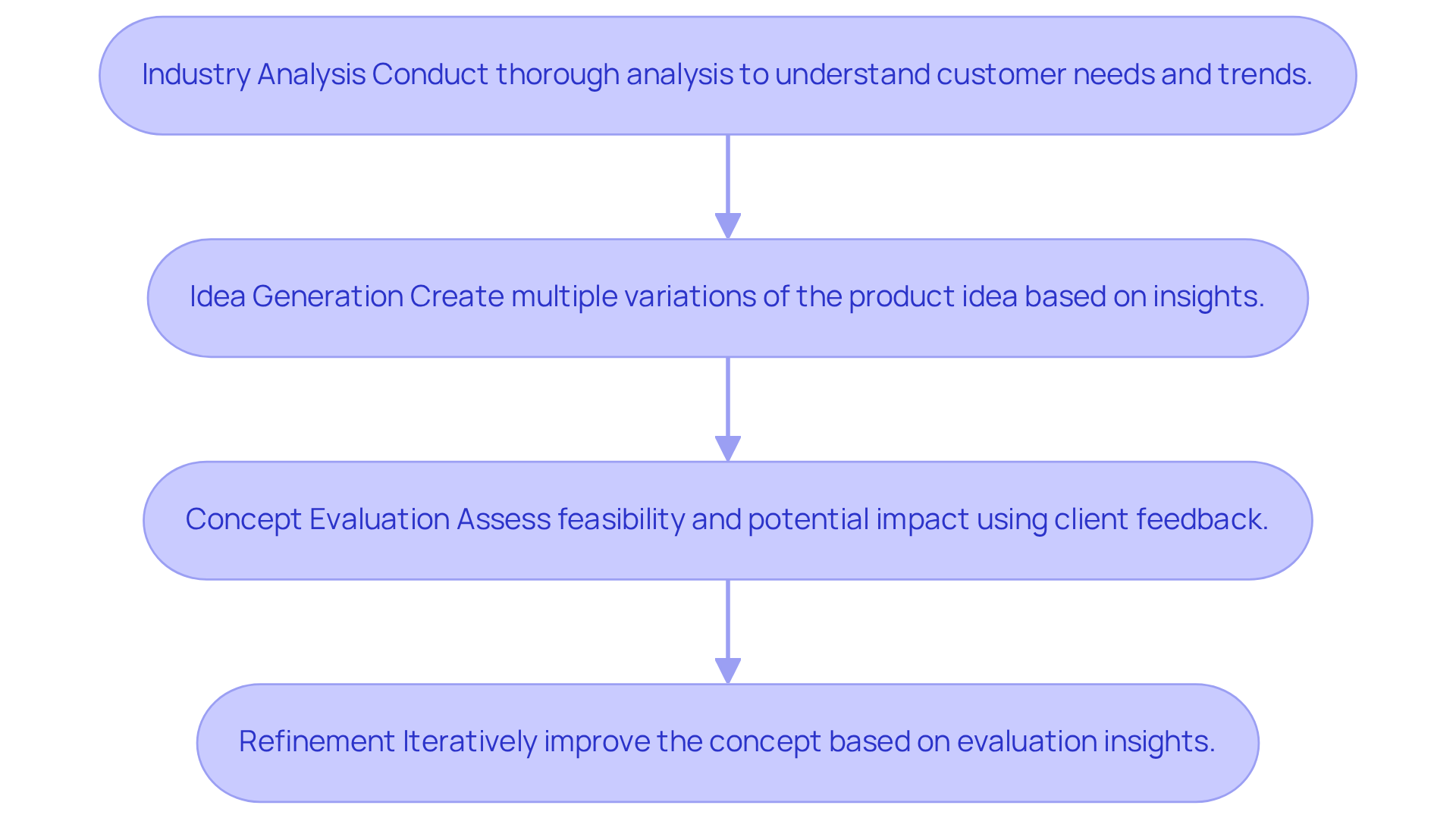
The idea development stage is pivotal in determining in which stage does one develop a concept for a product or service, as it transforms thoughts from the ideation phase into comprehensive designs. This stage encompasses several essential activities:
This stage lays the groundwork for subsequent development phases, making it critical for ensuring that the offering is both viable and competitive in the marketplace.
Comparative Analysis of Product Development Stages
Use english for answers
Please return corrected/formatted text for:
This analysis underscores the unique contributions of each stage, particularly highlighting the concept development phase as a crucial link between ideation and execution. This phase ensures that the item not only embodies innovation but also resonates with user needs, ultimately influencing its market success. The importance of setting clear success metrics early in the development process cannot be overstated, as it is essential for assessing success post-launch. Additionally, the overall failure rate, estimated between 25% and 45%, emphasizes the necessity for thorough validation and strategic alignment throughout these phases. Furthermore, customer demands (78%) and workforce challenges (65%) significantly impact product development efforts, making it imperative to address these factors during each phase. Incorporating agile methodologies can also enhance flexibility and responsiveness in the development process.

Conclusion
The journey of product development is intricate, with each stage playing a vital role in transforming innovative ideas into market-ready solutions. Among these stages, concept development stands out as a crucial link that ensures ideas are not only viable but also aligned with market needs. This phase is essential for refining initial thoughts into detailed concepts that resonate with users, thereby setting the foundation for a successful product launch.
Throughout this article, we have highlighted the significance of each stage in the product development process. From the brainstorming of ideas during the ideation phase to the tangible representations created in prototyping, and the critical feedback gathered in testing, each step contributes to a more robust and market-ready offering. The comparative analysis emphasizes the unique strengths and weaknesses of each stage, particularly showcasing how concept development integrates insights from market analysis and user feedback to enhance the likelihood of success.
In a competitive landscape, understanding and effectively navigating the product development process is paramount. Companies must prioritize thorough research and iterative refinement to ensure their offerings meet genuine customer needs. By embracing agile methodologies and maintaining a focus on compliance and user feedback, businesses can significantly improve their chances of delivering innovative products that not only capture market attention but also drive sustained engagement and success.
{"@context": "https://schema.org", "@type": "FAQPage", "mainEntity": [{"@type": "Question", "name": "What are the main stages of the product development process?", "acceptedAnswer": {"@type": "Answer", "text": "The main stages of the product development process are ideation, concept development, prototyping, testing, and launch."}}, {"@type": "Question", "name": "What is the purpose of the ideation phase?", "acceptedAnswer": {"@type": "Answer", "text": "The ideation phase focuses on brainstorming and generating ideas that align with market needs and opportunities. It is crucial for identifying promising ideas, as businesses often generate hundreds of ideas to find a few viable ones."}}, {"@type": "Question", "name": "Why is concept development important?", "acceptedAnswer": {"@type": "Answer", "text": "Concept development is important because it involves evolving selected ideas into detailed concepts, defining features, identifying the target audience, and assessing potential market fit. A comprehensive business plan is essential for analyzing economic factors and managing regulatory compliance."}}, {"@type": "Question", "name": "How does prototyping contribute to the product development process?", "acceptedAnswer": {"@type": "Answer", "text": "Prototyping contributes by creating a tangible representation of the concept, facilitating initial testing and feedback. It allows teams to validate usage hypotheses and refine the offering based on actual interactions."}}, {"@type": "Question", "name": "What role does testing play in product development?", "acceptedAnswer": {"@type": "Answer", "text": "Testing involves assessing prototypes with real users to gather insights and enhance the offering. It helps understand customer preferences, pinpoint areas for improvement, and ensures compliance, which mitigates risks."}}, {"@type": "Question", "name": "What happens during the market launch phase?", "acceptedAnswer": {"@type": "Answer", "text": "During the market launch phase, the product is introduced to the audience with the support of strategic marketing and sales plans. A well-executed launch is crucial for achieving visibility and meeting customer expectations."}}, {"@type": "Question", "name": "How can businesses enhance their chances of success in the product development process?", "acceptedAnswer": {"@type": "Answer", "text": "Businesses can enhance their chances of success by adhering to a structured approach, recognizing the importance of each phase, and proactively managing compliance throughout the development process."}}]}{"@context": "https://schema.org", "@type": "BlogPosting", "headline": "In Which Stage Do You Develop a Concept for a Product?", "description": "Discover in which stage does one develop a concept for a product or service to refine ideas into viable concepts.", "datePublished": "2025-09-08T00:00:08.828000", "image": ["https://cdn.prod.website-files.com/5fc90bae06ffc6ed06fd0e3c/68be256362b3573b28c0e939_gnwphshe-each-box-represents-a-stage-in-the-product-development-process-follow-the-arrows-to-see-how-each-stage-connects-to-the-next-guiding-the-transformation-from-an-idea-to-a-market-ready-product.webp", "https://cdn.prod.website-files.com/5fc90bae06ffc6ed06fd0e3c/68be256362b3573b28c0e936_vggfwhfh-0-aae-76-b-2-b-2-be-4-dd-3-a-6-c-7-d-6822-c-508219.webp", "https://cdn.prod.website-files.com/5fc90bae06ffc6ed06fd0e3c/68be256362b3573b28c0e933_zehloagk-each-box-represents-a-stage-in-product-development-the-arrows-show-how-the-process-flows-from-one-stage-to-the-next-while-the-bullet-points-highlight-important-aspects-of-each-stage-including-what-to-focus-on-strengths-and-potential-weaknesses.webp"], "articleBody": "## Overview\nThe Concept Development stage is pivotal in product development, where selected ideas are meticulously transformed into detailed concepts. These concepts define essential features, target audiences, and market fit, thereby ensuring alignment with market needs. Furthermore, this stage addresses regulatory and compliance requirements, significantly enhancing the likelihood of success. By establishing a clear path forward, it not only reinforces the product's relevance but also builds a solid foundation for future endeavors.\n\n## Introduction\nThe journey from a mere idea to a market-ready product is intricate and fraught with challenges; however, it is essential for any business aiming to innovate. Understanding when and how to develop a concept during the product development process can significantly influence the achievement of success. This article delves into the critical stages of product development, highlighting the pivotal role of concept development in transforming initial ideas into viable offerings. As companies navigate through ideation, prototyping, and testing, they often confront the pressing question: what truly defines a successful concept, and how can businesses ensure they are on the right path to market success?\n\n## Overview of the Product Development Process\nThe item development process comprises several essential stages: ideation, concept development, prototyping, testing, and launch. Each phase is critical in transforming an idea into a successful outcome, particularly regarding regulatory and compliance readiness.\n\n**Ideation**: This foundational phase emphasizes brainstorming and generating ideas that align with market needs and opportunities. Effective ideation significantly enhances the likelihood of creating a viable offering, as businesses typically generate hundreds of ideas to identify a few that show promise. Notably, statistics reveal that 80% of discussions surrounding new products never materialize, underscoring the importance of effective ideation and idea validation.\n\n**Concept Development**: This stage involves developing a concept for a product or service, as selected ideas evolve into detailed concepts. This process includes defining features, identifying the target audience, and assessing potential market fit. A comprehensive business plan is crucial, as it aids in analyzing economic factors and establishing a clear path forward. Furthermore, proactive management of regulatory and compliance requirements is vital to ensure that the offering aligns with industry standards. Studio Graphene employs specific compliance management strategies, such as regular audits and stakeholder consultations, to navigate these complexities effectively. According to the McKinsey Global Institute, for every seven concepts, only 1.5 are launched, and merely one succeeds, highlighting the challenges faced during development.\n\n**Prototyping**: This phase entails creating a tangible representation of the concept, facilitating initial testing and feedback. Prototyping is essential, as it enables teams to validate usage hypotheses and refine the offering based on actual interactions. Successful case studies, such as CityFALCON, illustrate this process; the project transitioned from a simple concept to a fully operational platform through iterative prototyping, significantly enhancing engagement and functionality.\n\n**Testing**: Prototypes undergo assessment with real users to gather insights and further enhance the offering. This stage is vital for [understanding customer preferences](https://blog.bit.ai/product-development-process) and pinpointing areas for improvement. Additionally, ensuring compliance during testing mitigates risks and bolsters the reliability of the item. Research indicates that rigorous testing can substantially reduce the chances of failure, which varies from 25% to 45% across industries. By incorporating user feedback during this phase, companies can better align their offerings with consumer needs. Studio Graphene prioritizes compliance checks during testing to ensure adherence to all regulatory standards, thereby minimizing potential liabilities.\n\n**Market Launch**: The final stage involves introducing the item to the audience, supported by strategic marketing and sales plans. A well-executed launch is crucial for achieving visibility and ensuring that the item meets customer expectations.\n\nRecognizing the importance of each phase in the development process is essential for guaranteeing an item's success in a competitive market environment. By adhering to a structured approach and proactively managing compliance, businesses can significantly enhance their chances of delivering innovative digital solutions that resonate with users.\n\n\n## Defining the Concept Development Stage\nThe idea development stage is pivotal in determining in which stage does one develop a concept for a product or service, as it transforms thoughts from the ideation phase into comprehensive designs. This stage encompasses several essential activities:\n\n1. Industry Analysis: Conducting thorough industry analysis is vital for understanding customer needs and identifying trends. This guarantees that the concept aligns with user expectations and meets genuine industry needs, prompting the question: in which stage does one develop a concept for a product or service? More than 85% of firms state that research ROI surpasses four times the investment, emphasizing its efficacy. Furthermore, about 80% of firms perform market analysis regularly, with 69% increasing their investment in this field to improve item relevance.\n\n2. Idea Generation: This involves creating multiple variations of the product idea, enabling teams to explore diverse possibilities and innovative features. Firms that leverage feedback from clients during this phase are often in which stage does one develop a concept for a product or service, allowing them to significantly enhance their idea's attractiveness and functionality. The growing demand for qualitative research underscores the importance of gathering insights from target audiences to guide idea generation.\n\n3. Concept Evaluation: Assessing the feasibility and potential impact of each concept is crucial. Client feedback and industry analysis play a crucial role in determining in which stage does one develop a concept for a product or service, as they provide insights into consumer preferences and potential challenges. For instance, American Express utilized market research to refine its customer service, resulting in a remarkable 400% increase in customer retention. This example illustrates how participant input is essential for efficiently assessing ideas.\n\n4. Refinement: Iterative improvement of the concept based on insights gathered during evaluation is essential. This process ensures that the final outcome is not only innovative but also market-ready, effectively addressing user needs and preferences, in which stage does one develop a concept for a product or service? The market research sector is projected to expand, reaching $35 billion within the next five years, highlighting the increasing significance of research in development.\n\nThis stage lays the groundwork for [subsequent development phases](https://askattest.com/blog/guides/market-research-new-product-development), making it critical for ensuring that the offering is both viable and competitive in the marketplace.\n\n\n## Comparative Analysis of Product Development Stages\nUse english for answers\n\nPlease return corrected/formatted text for:\n\n- **Stage**: Ideation \n - **Key Focus**: Generating ideas \n - **Strengths**: Encourages creativity and innovation, essential for identifying viable concepts. \n - **Weaknesses**: May lead to overwhelming options without focus. \n\n- **Stage**: Concept Development \n - **Key Focus**: Refining ideas into concepts \n - **Strengths**: Aligns product with market needs, ensuring relevance and potential success. \n - **Weaknesses**: Risk of over-complication or scope creep, which can dilute the original vision. \n\n- **Stage**: Prototyping \n - **Key Focus**: Creating tangible representations \n - **Strengths**: Allows for user testing and feedback, crucial for iterative improvement. \n - **Weaknesses**: Can be resource-intensive, requiring significant time and investment. \n\n- **Stage**: Testing \n - **Key Focus**: Validating product with users \n - **Strengths**: Provides critical insights for enhancement, increasing the likelihood of market fit. \n - **Weaknesses**: May not capture all user scenarios, potentially overlooking key feedback. \n\n- **Stage**: Market Launch \n - **Key Focus**: Introducing product to market \n - **Strengths**: Opportunity for revenue generation and establishes market presence. \n - **Weaknesses**: High stakes if offering fails to meet expectations, leading to significant losses. \n\nThis analysis underscores the unique contributions of each stage, particularly highlighting the [concept development phase](https://asana.com/resources/product-development-process) as a crucial link between ideation and execution. This phase ensures that the item not only embodies innovation but also resonates with user needs, ultimately influencing its market success. The importance of setting clear success metrics early in the development process cannot be overstated, as it is essential for assessing success post-launch. Additionally, the overall failure rate, estimated between 25% and 45%, emphasizes the necessity for thorough validation and strategic alignment throughout these phases. Furthermore, customer demands (78%) and workforce challenges (65%) significantly impact product development efforts, making it imperative to address these factors during each phase. Incorporating agile methodologies can also enhance flexibility and responsiveness in the development process.\n\n\n\n## Conclusion\nThe journey of product development is intricate, with each stage playing a vital role in transforming innovative ideas into market-ready solutions. Among these stages, concept development stands out as a crucial link that ensures ideas are not only viable but also aligned with market needs. This phase is essential for refining initial thoughts into detailed concepts that resonate with users, thereby setting the foundation for a successful product launch. \n\nThroughout this article, we have highlighted the significance of each stage in the product development process. From the brainstorming of ideas during the ideation phase to the tangible representations created in prototyping, and the critical feedback gathered in testing, each step contributes to a more robust and market-ready offering. The comparative analysis emphasizes the unique strengths and weaknesses of each stage, particularly showcasing how concept development integrates insights from market analysis and user feedback to enhance the likelihood of success. \n\nIn a competitive landscape, understanding and effectively navigating the product development process is paramount. Companies must prioritize thorough research and iterative refinement to ensure their offerings meet genuine customer needs. By embracing agile methodologies and maintaining a focus on compliance and user feedback, businesses can significantly improve their chances of delivering innovative products that not only capture market attention but also drive sustained engagement and success.\n\n::iframe[https://iframe.tely.ai/cta/eyJhcnRpY2xlX2lkIjogIjY4YmUxYzg4NDliMjAyYTUwNDJhN2NmOSIsICJjb21wYW55X2lkIjogIjY3YzVkZmRhMjY3MzljNjRhMWVjYjdiYSIsICJpbmRleCI6IG51bGwsICJ0eXBlIjogImFydGljbGUifQ==]{width=\"100%\" height=\"300px\"}"}