
AI
Insights
7 Key Benefits of Microservices for CTOs Driving Innovation

Overview
Microservices offer significant advantages for CTOs focused on driving innovation, such as enhanced agility, scalability, and operational efficiency. Notably, companies like Amazon, Netflix, and Spotify exemplify how microservices enable rapid deployment, independent scaling, and improved collaboration. These capabilities culminate in accelerated innovation and superior user experiences. By adopting microservices, organizations can effectively respond to market demands and foster a culture of continuous improvement.
Introduction
The rise of microservices architecture has fundamentally transformed how organizations innovate and deliver products in an increasingly competitive landscape. By deconstructing complex applications into smaller, manageable components, companies can significantly enhance agility, scalability, and operational efficiency.
However, as businesses adopt this modular approach, they encounter the intricate challenge of navigating its complexities while maximizing its benefits. What are the key advantages of microservices that CTOs should prioritize to drive innovation and ensure their organizations thrive in this dynamic environment?
Understanding these advantages is crucial for leaders aiming to stay ahead in the fast-evolving tech landscape.
Studio Graphene: Enhanced Agility Through Microservices Implementation
Studio Graphene leverages microservices to enhance agility within its product development lifecycle, showcasing the benefits of microservices while maintaining robust security and compliance oversight. By deconstructing applications into smaller, independent services, the agency leverages the benefits of microservices to swiftly adapt to evolving client needs and market demands. This modular approach showcases the benefits of microservices by facilitating faster iterations and promoting efficient collaboration among teams, ultimately accelerating the delivery of innovative solutions.
Comprehensive data security evaluations are routinely conducted to guarantee that all content, whether in transit or at rest, is securely encrypted. Furthermore, priority is given to capacity planning and sizing to optimize resource requirements, enabling auto-scaling during peak load times. Proactive compliance management is also essential, assisting organizations in navigating the complexities of regulatory requirements.
For instance, in projects like Canopy, the implementation of modular services highlighted the benefits of microservices, as it allowed for simultaneous work on various components, resulting in a more robust final product while adhering to regulatory compliance and best practices.

Amazon: Scalability and Flexibility with Microservices Architecture
Amazon's modular services architecture empowers the company to scale its offerings independently, adeptly managing millions of transactions with exceptional efficiency. This flexibility proves crucial during peak periods, such as the holiday shopping season, when demand surges. By leveraging a service-oriented architecture, Amazon can deploy new features and updates seamlessly, ensuring that existing services remain uninterrupted. This approach guarantees a consistently smooth user experience. Not only does this architecture enhance scalability, but it also supports the integration of advanced technologies like AI, further optimizing operational efficiency.
Notably, Amazon's maximum order processing capacity increased by 300%, while its transaction management capabilities soared from 100 transactions per second to over 600 transactions per second. This illustrates the significant benefits of microservices for enhancing scalability within e-commerce.
Furthermore, the implementation of a service mesh has bolstered system reliability, elevating availability from 99.9% to 99.99%, which translates to a remarkable reduction in downtime from 8.76 hours per year to just 52.56 minutes per year.
As Jeff Bezos wisely stated, 'If you never want to be criticized, for goodness’ sake don’t do anything new,' capturing the innovative spirit that drives Amazon's continuous enhancement through small service architectures. He also emphasized, 'The most crucial aspect is to concentrate intensely on the customer,' highlighting the customer-focused strategy that underpins Amazon's service-oriented approach.

Netflix: Rapid Deployment and Continuous Integration via Microservices
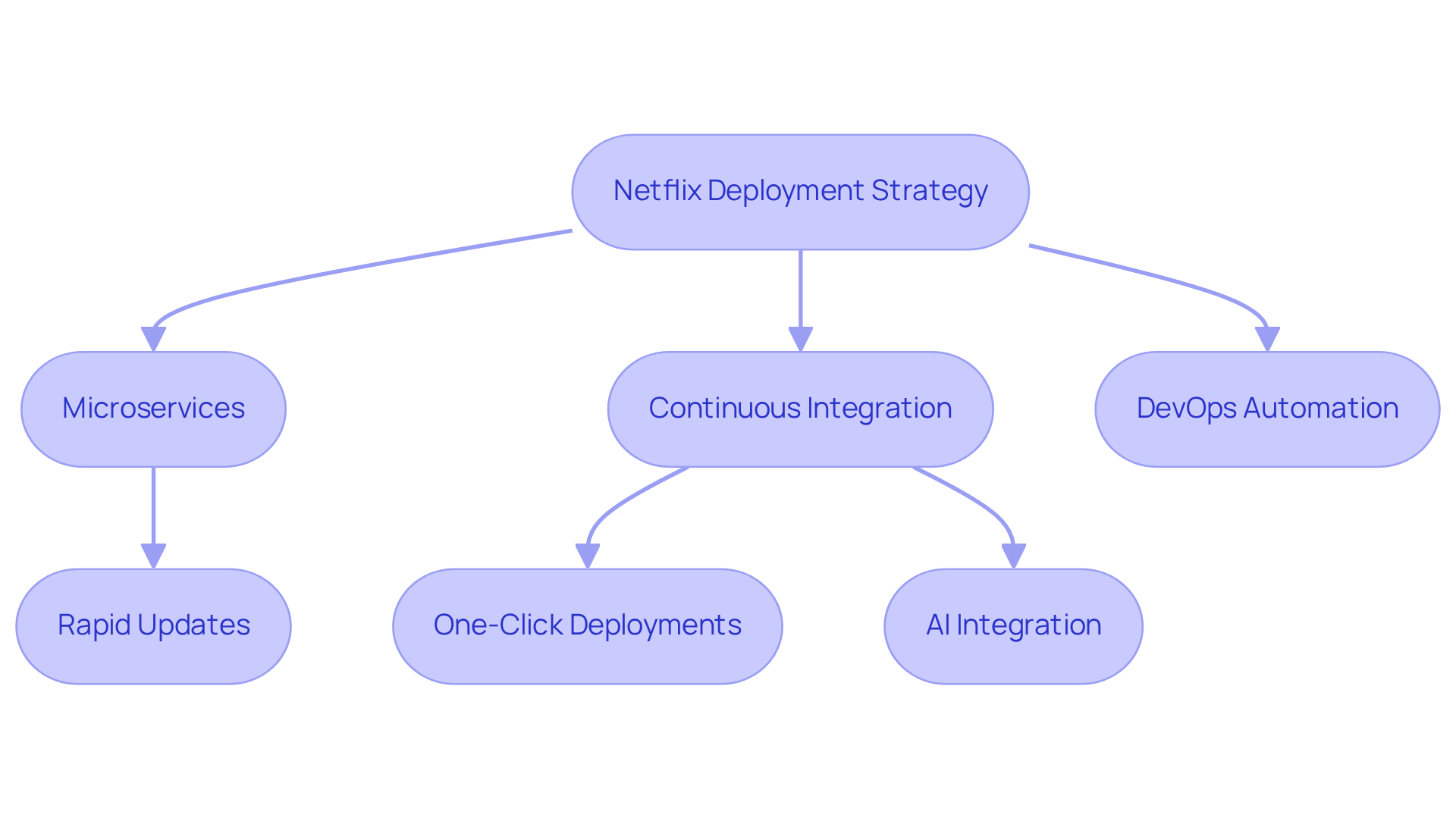
Netflix has effectively harnessed a service-oriented architecture to facilitate rapid deployment and continuous integration. This capability allows for thousands of updates each day without disrupting the overall system. By decoupling services, Netflix not only enhances agility but also illustrates the benefits of microservices by enabling swift responses to user feedback and evolving market demands, solidifying its leadership in the streaming industry. The architecture supports seamless integration of AI-driven recommendations, significantly boosting user engagement and satisfaction.
As highlighted by Netflix engineers, the adoption of continuous integration practices has been pivotal in scaling operations and fostering innovation, with deployment frequencies reaching unprecedented levels. Implementing one-click deployments and rollbacks—similar to the DevOps automation strategies at Studio Graphene—allows organizations to streamline their digital product updates, ensuring efficient delivery of new features and fixes. Furthermore, leveraging DevOps automation enhances security and incident management, enabling rapid restoration of services in the event of disruptions.
To maximize the benefits of microservices, organizations should prioritize the integration of continuous integration practices and DevOps automation into their development workflows. This strategic focus not only drives operational efficiency but also positions companies to respond proactively to market changes and customer needs.
Spotify: Improved User Experience and Reliability with Microservices
Spotify's implementation of a modular architecture has markedly enhanced its user experience and reliability. This approach allows Spotify to swiftly roll out new features and updates, ensuring users have access to the latest functionalities. Moreover, the benefits of microservices enhance system reliability, allowing individual services to be updated or scaled independently without disrupting the overall platform. Consequently, users enjoy a seamless streaming experience that keeps them engaged and satisfied.
Recent reports indicate that the benefits of microservices for Spotify's architecture support a service uptime of 99.99%, with error rates and request rates meticulously monitored to ensure optimal performance. As Oleksandr Lytvynenko, a Python Technical Lead, states, "The decentralized method aids in creating independent solutions that can function efficiently by integrating various technologies."
Furthermore, case studies reveal that by isolating services, Spotify has effectively contained failures, showcasing the benefits of microservices by ensuring that issues in one area do not cascade and impact the entire application. This strategic emphasis on modular services not only enhances operational efficiency but also positions Spotify as a leader in delivering an exceptional streaming experience.
For CTOs aiming to implement similar strategies, monitoring key performance metrics and adopting distributed tracing tools can yield valuable insights into system health and performance.

Walmart: Operational Efficiency and Resource Management through Microservices
Walmart has strategically embraced small service architectures to improve its operational efficiency and resource oversight, taking advantage of the benefits of microservices. By decomposing its applications into smaller, manageable services, the company takes advantage of the benefits of microservices to optimize its supply chain and inventory management processes. This service-oriented architecture demonstrates the benefits of microservices by enabling real-time data processing and analytics, which empowers Walmart to make swift, informed decisions. Consequently, the benefits of microservices lead to reduced operational costs, improved service delivery, and elevated customer satisfaction. Notably, the benefits of microservices are demonstrated by Walmart's use of modular services, which has led to a 50% rise in throughput during extreme market volatility, showcasing its effectiveness in adapting to changing demands. Furthermore, the incorporation of small services highlights the benefits of microservices by optimizing inventory oversight, improving alignment with regional preferences, and boosting overall responsiveness to market trends. This innovative approach not only enhances efficiency but also demonstrates the benefits of microservices in positioning Walmart as a leader in leveraging technology for improved resource control in retail.

Google Cloud: Leveraging Cloud Capabilities for Microservices Scalability
Google Cloud offers robust features that empower organizations to manage and scale their services effectively, significantly enhancing application performance. With capabilities like auto-scaling and load balancing, businesses can ensure responsiveness amid fluctuating demand and rapid growth. This scalability is essential for companies aiming to innovate without the burden of complex infrastructure management.
A Technical Solutions Engineer notes, "Cloud technology has evolved rapidly over the past two years, fundamentally reshaping how businesses operate, collaborate, and deliver services."
By leveraging Google Cloud's strong infrastructure, organizations can concentrate on developing innovative solutions, confident that their services will perform effectively under varying demands. Furthermore, the Cloud Service Market is projected to expand at a CAGR of 21.4% from 2024 to 2032, underscoring the increasing importance of efficient service management in today's digital landscape.

IBM: Streamlined Development Processes with Microservices Tools
IBM has introduced a robust suite of tools designed to streamline the development processes associated with distributed services. These solutions enhance the management of smaller services, highlighting the benefits of microservices by empowering teams to deploy, monitor, and scale their software with remarkable efficiency. By offering a comprehensive array of resources, IBM enables organizations to confidently adopt service-oriented architectures, thereby ensuring sustained productivity and promoting innovation.
For instance, organizations utilizing IBM's service orchestration tools have reported significant improvements in their operational workflows, with many noting a marked increase in deployment frequency and application performance. Industry statistics reveal that companies implementing modular services experience a 35% boost in development speed alongside a 17% rise in developer productivity.
As an IBM expert highlighted, 'Our tools are crafted to simplify the complexities of service-oriented architecture, enabling teams to focus on delivering value rather than being bogged down by organizational challenges.' This commitment to enhancing productivity through the effective management of smaller services showcases the benefits of microservices, as reflected in the positive outcomes observed by companies leveraging IBM's solutions.
Furthermore, case studies, such as Netflix's transition to a service-oriented architecture, illustrate how these tools can lead to improved software efficiency and operational productivity.

Akamai: Security and Performance in Microservices Architecture
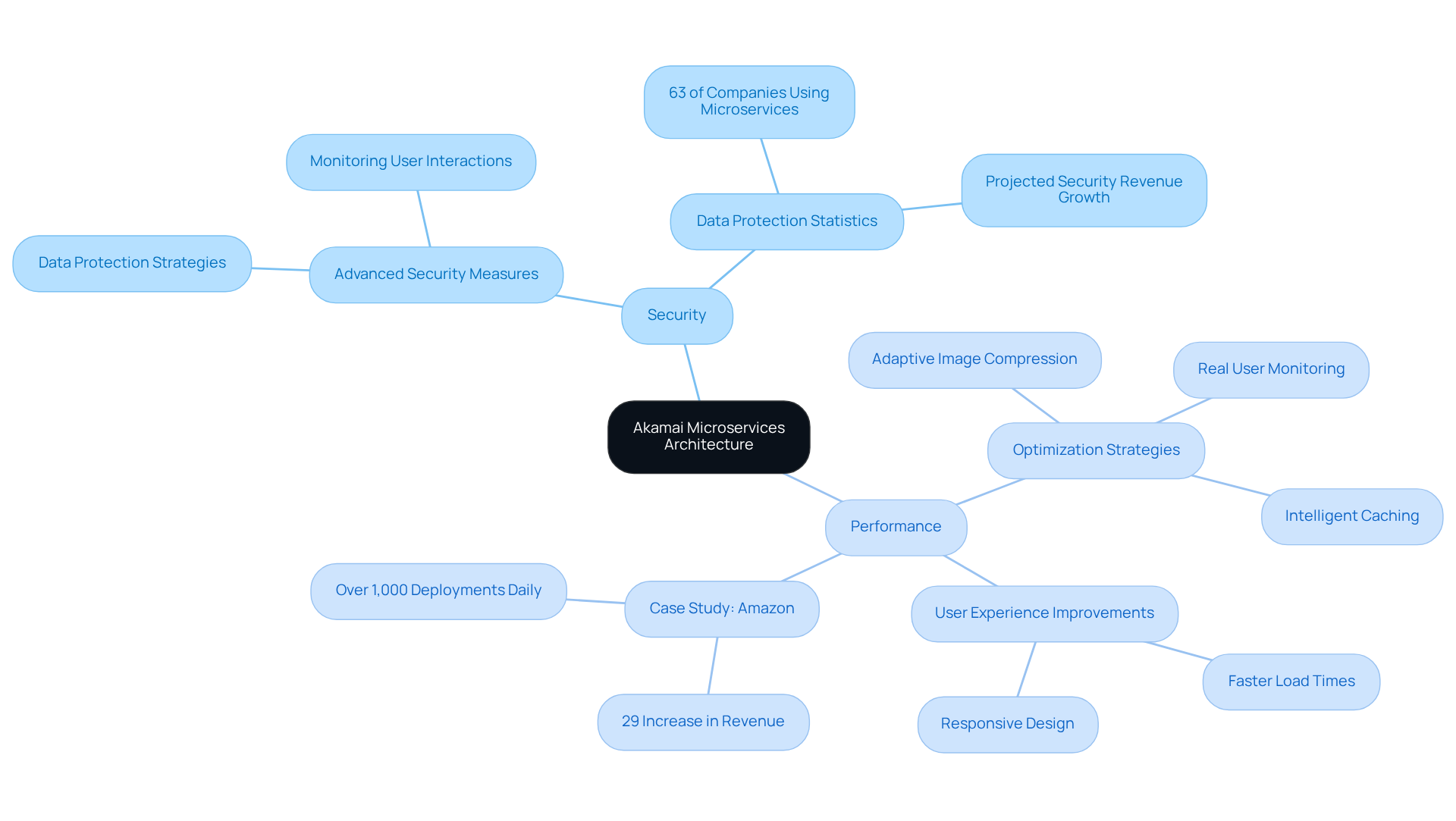
Akamai's architecture is meticulously designed with a dual focus on security and efficiency, which are crucial for organizations that depend on these systems to deliver essential services. By implementing advanced security measures, Akamai effectively safeguards sensitive data and reduces the risk of unauthorized access, addressing the increasing security challenges associated with a distributed architecture. This unwavering commitment to security is vital, particularly as 63% of companies leverage the benefits of microservices to enhance software efficiency and boost customer satisfaction.
In addition to robust security protocols, Akamai applies optimization strategies that ensure applications remain responsive and efficient. Techniques such as adaptive image compression and intelligent caching tailored to device characteristics significantly improve user experience, especially in mobile contexts. The integration of real user monitoring, for example, allows for continuous assessment of user interactions, enabling proactive adjustments to maintain optimal functionality.
Recent case studies underscore the efficacy of these strategies. For instance, Amazon's transition to microservices demonstrated the benefits of microservices by resulting in a remarkable 29% increase in revenue, illustrating how such enhancements can drive business growth. Akamai's executives assert that optimizing front-end performance is essential, as a significant portion of an end user’s wait time occurs there. This layered approach to performance—encompassing acceleration, prefetching, and payload reduction—ensures that applications not only meet but surpass user expectations, ultimately fostering increased customer retention and satisfaction.
Atlassian: Enhancing Collaboration and Productivity in Microservices Management
Atlassian offers a robust collection of tools specifically designed to enhance collaboration and productivity in service management. These platforms for project tracking, documentation, and communication empower teams to collaborate more effectively, enhancing transparency and accountability. Consequently, all team members remain aligned with project goals and timelines. This alignment allows organizations to optimize their service development processes, resulting in increased efficiency and faster feature delivery.
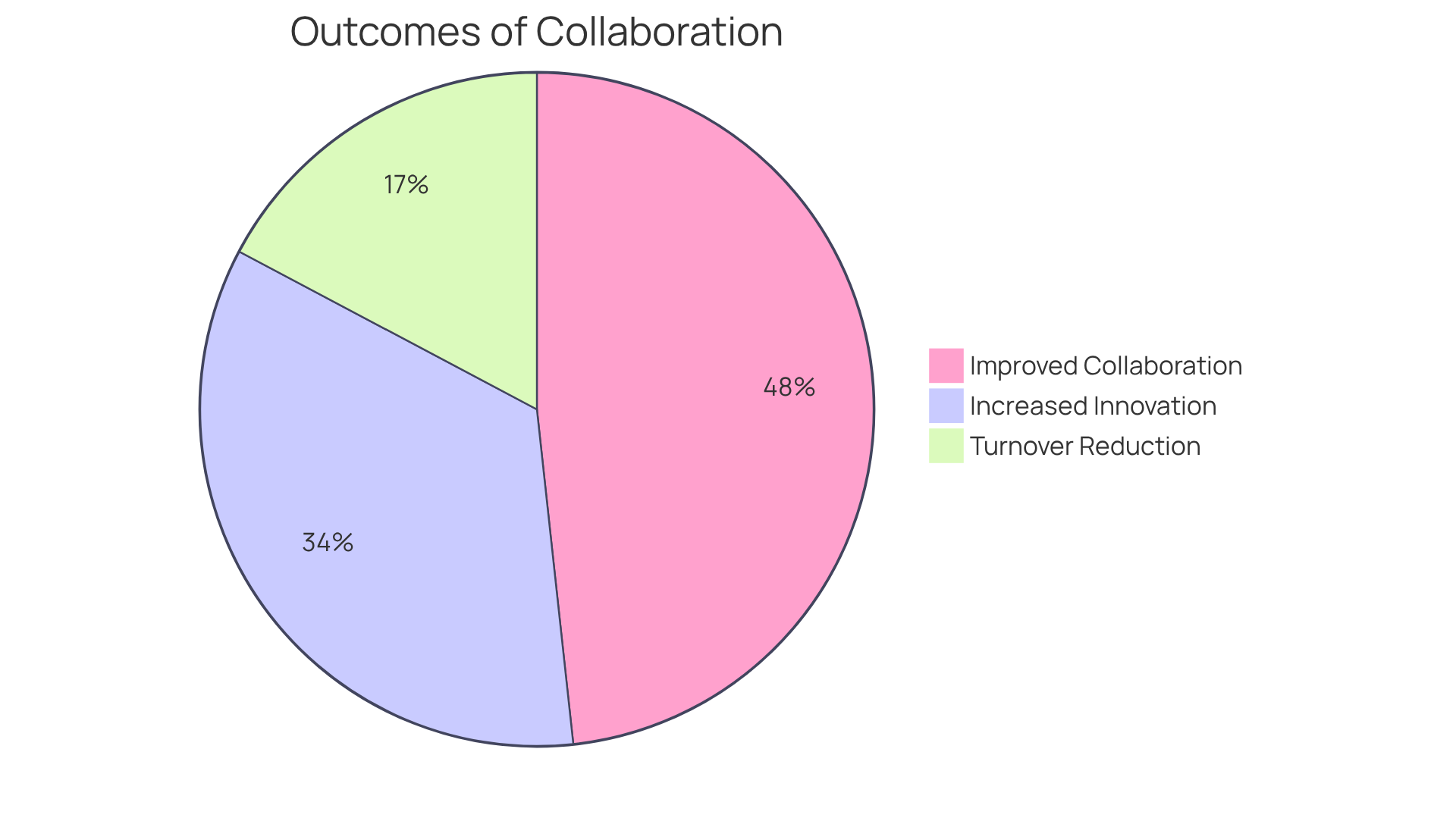
Notably, 84% of businesses report improved collaboration after adopting a modular approach, while companies that foster teamwork anticipate a 30% reduction in employee turnover. The integration of Atlassian's tools significantly contributes to achieving these outcomes.
As an Atlassian representative states, "Our tools are designed to not only improve collaboration but also to drive innovation, as 60% of employees are more innovative in a collaborative environment."
Furthermore, the potential for enhanced software quality and efficiency underscores the substantial benefits of microservices when employing Atlassian's solutions in managing service-oriented architectures.
Payara: Optimizing Microservices Performance and Deployment
Payara delivers innovative solutions that significantly enhance the performance and deployment of service-oriented architectures, enabling organizations to achieve quicker startup times and reduced resource usage. By leveraging Payara's tools, such as Payara Starter for automated code creation of Jakarta EE/MicroProfile projects, teams can streamline their deployment processes, ensuring optimal service efficiency. This optimization is crucial for maintaining high availability and responsiveness in systems, ultimately leading to improved user satisfaction and better business outcomes.
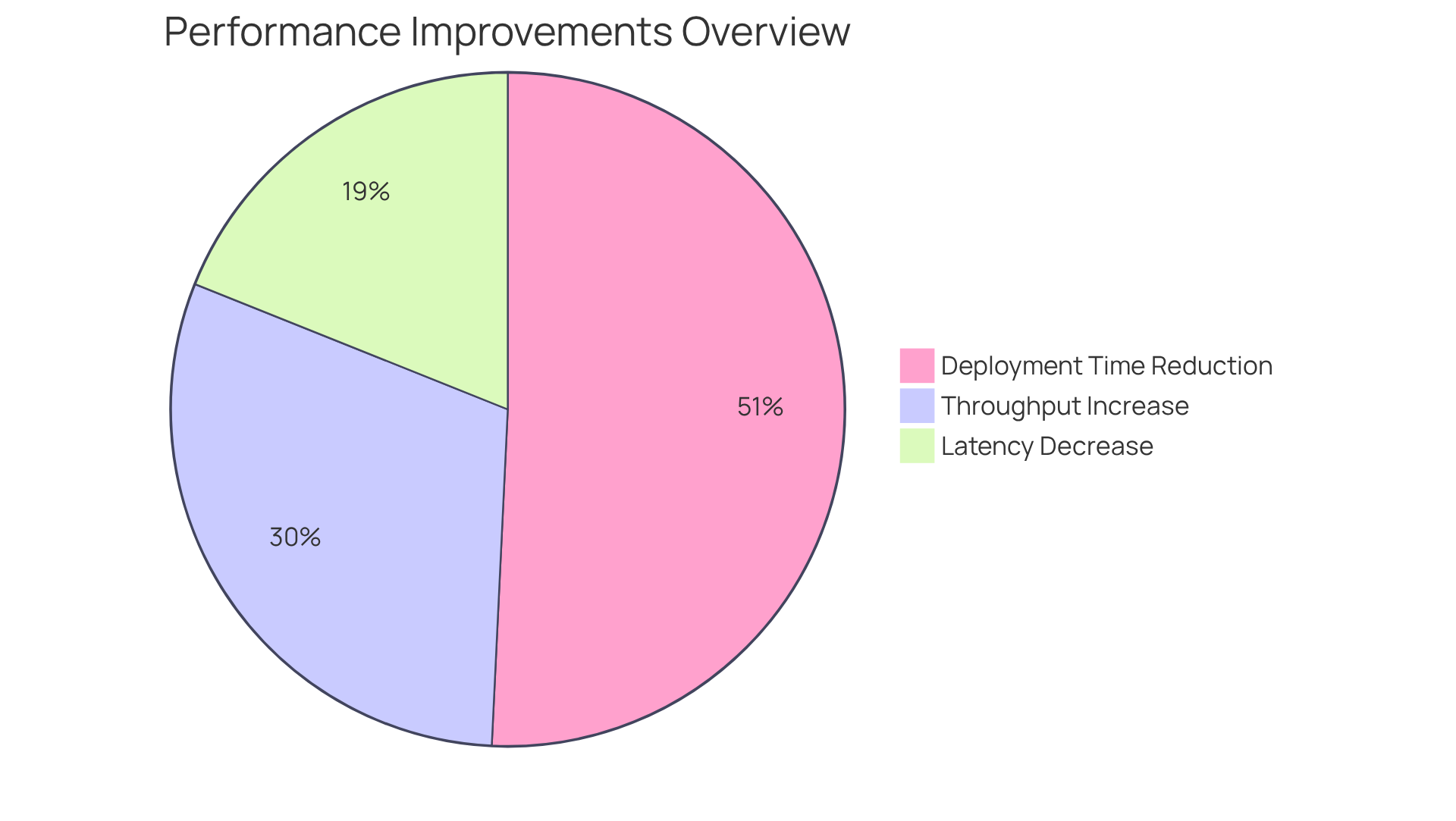
Organizations that have adopted Payara's service-oriented tools report an impressive 67% reduction in deployment time, facilitating rapid prototyping and accelerating time-to-market. Furthermore, the hybrid approach that balances speed and control in application development and deployment is a significant advantage of utilizing Payara's solutions. Case studies illustrate that companies employing Payara have experienced a 40% increase in throughput and a 25% decrease in latency, underscoring the tangible benefits of effective service deployment.
Developers from Payara assert that their solutions not only simplify the deployment process but also empower teams to concentrate on innovation, driving substantial enhancements in operational efficiency. For organizations aiming to refine their microservices strategy, recognizing the benefits of microservices through embracing Payara's tools can indeed be a transformative decision.
Conclusion
The exploration of microservices unveils their transformative potential for organizations seeking to innovate and enhance operational efficiency. By adopting a microservices architecture, businesses can enjoy increased agility, scalability, and collaboration—attributes that are indispensable in today’s fast-paced digital landscape. The insights shared throughout this article illustrate how leading companies, including Studio Graphene, Amazon, and Netflix, have effectively implemented microservices to meet evolving market demands and elevate user experiences.
Key arguments emphasize the benefits of microservices, such as:
Furthermore, the focus on security, performance optimization, and collaboration tools highlights the multifaceted advantages that microservices provide. As organizations increasingly acknowledge the value of this architecture, the path to innovation becomes clearer, showcasing the significant impact microservices can have on business operations.
For CTOs and decision-makers, embracing microservices transcends a mere technical choice; it is a strategic imperative. The case studies presented demonstrate that leveraging microservices can yield substantial improvements in efficiency, user satisfaction, and overall business performance. By prioritizing the integration of microservices into their development strategies, organizations can position themselves for long-term success in a competitive landscape. The journey toward adopting microservices is a vital step in driving innovation and achieving operational excellence.
{"@context": "https://schema.org", "@type": "FAQPage", "mainEntity": [{"@type": "Question", "name": "What are microservices and how do they benefit product development?", "acceptedAnswer": {"@type": "Answer", "text": "Microservices are a modular approach to application development that involves breaking down applications into smaller, independent services. This enhances agility by allowing teams to adapt quickly to client needs and market demands, facilitating faster iterations and promoting efficient collaboration."}}, {"@type": "Question", "name": "How does Studio Graphene utilize microservices?", "acceptedAnswer": {"@type": "Answer", "text": "Studio Graphene leverages microservices to enhance agility in its product development lifecycle. This approach allows for swift adaptation to evolving client needs, promotes collaboration among teams, and accelerates the delivery of innovative solutions while maintaining security and compliance."}}, {"@type": "Question", "name": "What security measures does Studio Graphene implement when using microservices?", "acceptedAnswer": {"@type": "Answer", "text": "Studio Graphene conducts comprehensive data security evaluations to ensure that all content is securely encrypted, both in transit and at rest. They also prioritize capacity planning and sizing to optimize resource requirements and enable auto-scaling during peak load times."}}, {"@type": "Question", "name": "How does Amazon benefit from microservices architecture?", "acceptedAnswer": {"@type": "Answer", "text": "Amazon's modular services architecture allows for independent scaling of offerings, managing millions of transactions efficiently, especially during peak periods. This architecture enhances scalability, supports seamless feature deployment, and integrates advanced technologies like AI, optimizing operational efficiency."}}, {"@type": "Question", "name": "What improvements has Amazon experienced due to microservices?", "acceptedAnswer": {"@type": "Answer", "text": "Amazon's maximum order processing capacity increased by 300%, and transaction management capabilities improved from 100 transactions per second to over 600 transactions per second. Additionally, system reliability was enhanced, increasing availability from 99.9% to 99.99%."}}, {"@type": "Question", "name": "How does Netflix utilize microservices for deployment?", "acceptedAnswer": {"@type": "Answer", "text": "Netflix employs a service-oriented architecture that facilitates rapid deployment and continuous integration, allowing for thousands of updates each day without disrupting the overall system. This enables swift responses to user feedback and evolving market demands."}}, {"@type": "Question", "name": "What practices does Netflix adopt to maximize the benefits of microservices?", "acceptedAnswer": {"@type": "Answer", "text": "Netflix emphasizes continuous integration practices and DevOps automation to streamline digital product updates, allowing for one-click deployments and rollbacks. This enhances operational efficiency and positions the company to respond proactively to market changes and customer needs."}}, {"@type": "Question", "name": "What is the significance of DevOps automation in microservices?", "acceptedAnswer": {"@type": "Answer", "text": "DevOps automation enhances security and incident management, enabling rapid restoration of services in the event of disruptions. It is crucial for organizations looking to maximize the benefits of microservices and improve their development workflows."}}]}{"@context": "https://schema.org", "@type": "BlogPosting", "headline": "7 Key Benefits of Microservices for CTOs Driving Innovation", "description": "Discover the key benefits of microservices and how they drive innovation for CTOs.", "datePublished": "2025-09-10T00:45:32.061000", "image": ["https://cdn.prod.website-files.com/5fc90bae06ffc6ed06fd0e3c/68c0cdfea9d97a202e021713_bjmfhdrw-begin-at-the-center-with-the-concept-of-microservices-each-branch-represents-a-major-benefit-and-the-sub-branches-provide-more-detail-about-each-aspect-helping-you-understand-how-microservices-enhance-overall-product-development.webp", "https://cdn.prod.website-files.com/5fc90bae06ffc6ed06fd0e3c/68c0cdfea9d97a202e02171c_xjadeqml-this-flowchart-shows-how-amazons-microservices-architecture-leads-to-significant-improvements-in-scalability-transaction-management-and-system-reliability-each-box-represents-a-key-area-of-improvement-with-specific-metrics-illustrating-the-impact.webp", "https://cdn.prod.website-files.com/5fc90bae06ffc6ed06fd0e3c/68c0cdfea9d97a202e021719_nciydvos-this-flowchart-outlines-how-netflix-leverages-microservices-continuous-integration-and-dev-ops-automation-to-enhance-their-deployment-processes-each-box-represents-a-key-component-showing-how-they-connect-to-create-a-streamlined-approach-to-updates-and-operational-efficiency.webp", "https://cdn.prod.website-files.com/5fc90bae06ffc6ed06fd0e3c/68c0cdfea9d97a202e021710_vyidjiwg-each-step-shows-how-spotifys-adoption-of-microservices-leads-to-benefits-follow-the-arrows-to-see-how-each-element-contributes-to-the-overall-improvement-in-user-experience-and-reliability.webp", "https://cdn.prod.website-files.com/5fc90bae06ffc6ed06fd0e3c/68c0cdfea9d97a202e02170a_vwrhsoah-the-center-shows-walmarts-main-strategy-with-branches-illustrating-the-key-benefits-of-microservices-follow-the-branches-to-explore-how-each-benefit-contributes-to-walmarts-operational-success.webp", "https://cdn.prod.website-files.com/5fc90bae06ffc6ed06fd0e3c/68c0cdfea9d97a202e02170d_mvmxwjof-each-step-in-the-flowchart-shows-how-google-cloud-features-contribute-to-better-service-management-and-scalability-follow-the-arrows-to-see-how-each-feature-leads-to-enhanced-performance-and-innovation.webp", "https://cdn.prod.website-files.com/5fc90bae06ffc6ed06fd0e3c/68c0cdfea9d97a202e021704_wxzawgtb-the-central-node-represents-ib-ms-microservices-tools-while-the-branches-illustrate-related-benefits-statistics-expert-insights-and-case-studies-each-branch-shows-how-these-elements-contribute-to-understanding-the-overall-impact-of-ib-ms-offerings.webp", "https://cdn.prod.website-files.com/5fc90bae06ffc6ed06fd0e3c/68c0cdfea9d97a202e021701_pspybbeg-the-center-shows-akamais-focus-while-the-branches-illustrate-key-areas-security-and-performance-each-sub-branch-provides-specific-strategies-or-statistics-that-support-the-main-ideas.webp", "https://cdn.prod.website-files.com/5fc90bae06ffc6ed06fd0e3c/68c0cdfea9d97a202e021707_kvkhdblm-eefc-2-fd-8-8-a-3-a-4588-9219-4-dff-25-b-5049-e.webp", "https://cdn.prod.website-files.com/5fc90bae06ffc6ed06fd0e3c/68c0cdfea9d97a202e021716_ktufyhap-092-b-8245-d-974-41-f-4-b-2-cb-2-a-74-ac-47609-c.webp"], "articleBody": "## Overview\nMicroservices offer significant advantages for CTOs focused on driving innovation, such as enhanced agility, scalability, and operational efficiency. Notably, companies like Amazon, Netflix, and Spotify exemplify how microservices enable rapid deployment, independent scaling, and improved collaboration. These capabilities culminate in accelerated innovation and superior user experiences. By adopting microservices, organizations can effectively respond to market demands and foster a culture of continuous improvement.\n\n## Introduction\nThe rise of microservices architecture has fundamentally transformed how organizations innovate and deliver products in an increasingly competitive landscape. By deconstructing complex applications into smaller, manageable components, companies can significantly enhance agility, scalability, and operational efficiency. \n\nHowever, as businesses adopt this modular approach, they encounter the intricate challenge of navigating its complexities while maximizing its benefits. What are the key advantages of microservices that CTOs should prioritize to drive innovation and ensure their organizations thrive in this dynamic environment? \n\nUnderstanding these advantages is crucial for leaders aiming to stay ahead in the fast-evolving tech landscape.\n\n## Studio Graphene: Enhanced Agility Through Microservices Implementation\nStudio Graphene leverages microservices to enhance agility within its product development lifecycle, showcasing the benefits of microservices while maintaining robust security and compliance oversight. By deconstructing applications into smaller, independent services, the agency leverages the benefits of microservices to swiftly adapt to evolving client needs and market demands. This [modular approach](https://codal.com/insights/understanding-the-rise-of-microservice-architecture) showcases the benefits of microservices by facilitating faster iterations and promoting efficient collaboration among teams, ultimately accelerating the delivery of innovative solutions. \n\nComprehensive data security evaluations are routinely conducted to guarantee that all content, whether in transit or at rest, is securely encrypted. Furthermore, priority is given to capacity planning and sizing to optimize resource requirements, enabling auto-scaling during peak load times. Proactive compliance management is also essential, assisting organizations in navigating the complexities of regulatory requirements. \n\nFor instance, in projects like Canopy, the implementation of modular services highlighted the benefits of microservices, as it allowed for simultaneous work on various components, resulting in a more robust final product while adhering to regulatory compliance and best practices.\n\n\n## Amazon: Scalability and Flexibility with Microservices Architecture\nAmazon's modular services architecture empowers the company to scale its offerings independently, adeptly managing millions of transactions with exceptional efficiency. This flexibility proves crucial during peak periods, such as the holiday shopping season, when demand surges. By leveraging a service-oriented architecture, Amazon can deploy new features and updates seamlessly, ensuring that existing services remain uninterrupted. This approach guarantees a consistently smooth user experience. Not only does this architecture enhance scalability, but it also supports the integration of advanced technologies like AI, further optimizing operational efficiency. \n\nNotably, Amazon's [maximum order processing capacity increased by 300%](https://ijraset.com/research-paper/leveraging-aws-and-java-microservices-an-analysis-of-amazons-scalable-e-commerce-architecture), while its transaction management capabilities soared from 100 transactions per second to over 600 transactions per second. This illustrates the significant benefits of microservices for enhancing scalability within e-commerce. \n\nFurthermore, the implementation of a service mesh has bolstered system reliability, elevating availability from 99.9% to 99.99%, which translates to a remarkable reduction in downtime from 8.76 hours per year to just 52.56 minutes per year. \n\nAs Jeff Bezos wisely stated, 'If you never want to be criticized, for goodness\u2019 sake don\u2019t do anything new,' capturing the innovative spirit that drives Amazon's continuous enhancement through small service architectures. He also emphasized, 'The most crucial aspect is to concentrate intensely on the customer,' highlighting the customer-focused strategy that underpins Amazon's service-oriented approach.\n\n\n## Netflix: Rapid Deployment and Continuous Integration via Microservices\nNetflix has effectively harnessed a service-oriented architecture to facilitate rapid deployment and continuous integration. This capability allows for thousands of updates each day without disrupting the overall system. By decoupling services, Netflix not only enhances agility but also illustrates the benefits of microservices by enabling swift responses to user feedback and evolving market demands, solidifying its leadership in the streaming industry. The architecture supports seamless integration of AI-driven recommendations, significantly boosting user engagement and satisfaction. \n\nAs highlighted by Netflix engineers, the adoption of continuous integration practices has been pivotal in scaling operations and fostering innovation, with deployment frequencies reaching unprecedented levels. Implementing one-click deployments and rollbacks\u2014similar to the DevOps automation strategies at Studio Graphene\u2014allows organizations to streamline their digital product updates, ensuring efficient delivery of new features and fixes. Furthermore, leveraging DevOps automation enhances security and incident management, enabling rapid restoration of services in the event of disruptions. \n\nTo [maximize the benefits of microservices](https://leanix.net/en/blog/why-netflix-amazon-and-apple-care-about-microservices), organizations should prioritize the integration of continuous integration practices and DevOps automation into their development workflows. This strategic focus not only drives operational efficiency but also positions companies to respond proactively to market changes and customer needs.\n\n\n## Spotify: Improved User Experience and Reliability with Microservices\nSpotify's implementation of a modular architecture has markedly enhanced its user experience and reliability. This approach allows Spotify to swiftly roll out new features and updates, ensuring users have access to the latest functionalities. Moreover, the benefits of microservices enhance system reliability, allowing individual services to be updated or scaled independently without disrupting the overall platform. Consequently, users enjoy a seamless streaming experience that keeps them engaged and satisfied. \n\nRecent reports indicate that the benefits of microservices for Spotify's architecture support a service uptime of 99.99%, with error rates and request rates meticulously monitored to ensure optimal performance. As Oleksandr Lytvynenko, a Python Technical Lead, states, \"The decentralized method aids in creating independent solutions that can function efficiently by integrating various technologies.\" \n\nFurthermore, case studies reveal that by isolating services, Spotify has effectively contained failures, showcasing the benefits of microservices by ensuring that issues in one area do not cascade and impact the entire application. This strategic emphasis on modular services not only enhances [operational efficiency](https://codeit.us/blog/benefits-of-microservices) but also positions Spotify as a leader in delivering an exceptional streaming experience. \n\nFor CTOs aiming to implement similar strategies, monitoring key performance metrics and adopting distributed tracing tools can yield valuable insights into system health and performance.\n\n\n## Walmart: Operational Efficiency and Resource Management through Microservices\nWalmart has strategically embraced small service architectures to improve its operational efficiency and resource oversight, taking advantage of the [benefits of microservices](https://zoetalentsolutions.com/blockchain-impact-on-supply-chain-efficiency-metrics). By decomposing its applications into smaller, manageable services, the company takes advantage of the benefits of microservices to optimize its supply chain and inventory management processes. This service-oriented architecture demonstrates the benefits of microservices by enabling real-time data processing and analytics, which empowers Walmart to make swift, informed decisions. Consequently, the benefits of microservices lead to reduced operational costs, improved service delivery, and elevated customer satisfaction. Notably, the benefits of microservices are demonstrated by Walmart's use of modular services, which has led to a 50% rise in throughput during extreme market volatility, showcasing its effectiveness in adapting to changing demands. Furthermore, the incorporation of small services highlights the benefits of microservices by optimizing inventory oversight, improving alignment with regional preferences, and boosting overall responsiveness to market trends. This innovative approach not only enhances efficiency but also demonstrates the benefits of microservices in positioning Walmart as a leader in leveraging technology for improved resource control in retail.\n\n\n## Google Cloud: Leveraging Cloud Capabilities for Microservices Scalability\nGoogle Cloud offers robust features that empower organizations to manage and scale their services effectively, significantly enhancing application performance. With capabilities like [auto-scaling and load balancing](https://itdeskuk.com/latest-cloud-statistics), businesses can ensure responsiveness amid fluctuating demand and rapid growth. This scalability is essential for companies aiming to innovate without the burden of complex infrastructure management. \n\nA Technical Solutions Engineer notes, \"Cloud technology has evolved rapidly over the past two years, fundamentally reshaping how businesses operate, collaborate, and deliver services.\" \n\nBy leveraging Google Cloud's strong infrastructure, organizations can concentrate on developing innovative solutions, confident that their services will perform effectively under varying demands. Furthermore, the Cloud Service Market is projected to expand at a CAGR of 21.4% from 2024 to 2032, underscoring the increasing importance of efficient service management in today's digital landscape.\n\n\n## IBM: Streamlined Development Processes with Microservices Tools\nIBM has introduced a robust suite of tools designed to streamline the development processes associated with distributed services. These solutions enhance the management of smaller services, highlighting the benefits of microservices by empowering teams to deploy, monitor, and scale their software with remarkable efficiency. By offering a comprehensive array of resources, IBM enables organizations to confidently adopt service-oriented architectures, thereby ensuring sustained productivity and promoting innovation. \n\nFor instance, organizations utilizing IBM's service orchestration tools have reported significant improvements in their operational workflows, with many noting a marked increase in deployment frequency and application performance. Industry statistics reveal that companies implementing modular services experience a 35% boost in development speed alongside a 17% rise in developer productivity. \n\nAs an IBM expert highlighted, 'Our tools are crafted to simplify the complexities of service-oriented architecture, enabling teams to focus on delivering value rather than being bogged down by organizational challenges.' This commitment to enhancing productivity through the effective management of smaller services showcases the benefits of microservices, as reflected in the [positive outcomes observed by companies leveraging IBM's solutions](https://moldstud.com/articles/p-the-impact-of-microservices-architecture-on-development). \n\nFurthermore, case studies, such as Netflix's transition to a service-oriented architecture, illustrate how these tools can lead to improved software efficiency and operational productivity.\n\n\n## Akamai: Security and Performance in Microservices Architecture\nAkamai's architecture is meticulously designed with a dual focus on security and efficiency, which are crucial for organizations that depend on these systems to deliver essential services. By implementing advanced security measures, Akamai effectively safeguards sensitive data and reduces the risk of unauthorized access, addressing the increasing security challenges associated with a distributed architecture. This unwavering commitment to security is vital, particularly as 63% of companies leverage the [benefits of microservices](https://fortunesoftit.com/optimize-application-performance-with-microservice) to enhance software efficiency and boost customer satisfaction.\n\nIn addition to robust security protocols, Akamai applies optimization strategies that ensure applications remain responsive and efficient. Techniques such as adaptive image compression and intelligent caching tailored to device characteristics significantly improve user experience, especially in mobile contexts. The integration of real user monitoring, for example, allows for continuous assessment of user interactions, enabling proactive adjustments to maintain optimal functionality.\n\nRecent case studies underscore the efficacy of these strategies. For instance, Amazon's transition to microservices demonstrated the benefits of microservices by resulting in a remarkable 29% increase in revenue, illustrating how such enhancements can drive business growth. Akamai's executives assert that optimizing front-end performance is essential, as a significant portion of an end user\u2019s wait time occurs there. This layered approach to performance\u2014encompassing acceleration, prefetching, and payload reduction\u2014ensures that applications not only meet but surpass user expectations, ultimately fostering increased customer retention and satisfaction.\n\n\n## Atlassian: Enhancing Collaboration and Productivity in Microservices Management\nAtlassian offers a robust collection of tools specifically designed to enhance collaboration and productivity in service management. These platforms for project tracking, documentation, and communication empower teams to [collaborate more effectively](https://b2breviews.com/workplace-collaboration-statistics), enhancing transparency and accountability. Consequently, all team members remain aligned with project goals and timelines. This alignment allows organizations to optimize their service development processes, resulting in increased efficiency and faster feature delivery. \n\nNotably, 84% of businesses report improved collaboration after adopting a modular approach, while companies that foster teamwork anticipate a 30% reduction in employee turnover. The integration of Atlassian's tools significantly contributes to achieving these outcomes. \n\nAs an Atlassian representative states, \"Our tools are designed to not only improve collaboration but also to drive innovation, as 60% of employees are more innovative in a collaborative environment.\" \n\nFurthermore, the potential for enhanced software quality and efficiency underscores the substantial benefits of microservices when employing Atlassian's solutions in managing service-oriented architectures.\n\n\n## Payara: Optimizing Microservices Performance and Deployment\nPayara delivers innovative solutions that significantly enhance the performance and deployment of service-oriented architectures, enabling organizations to achieve quicker startup times and reduced resource usage. By leveraging Payara's tools, such as Payara Starter for automated code creation of Jakarta EE/MicroProfile projects, teams can streamline their deployment processes, ensuring optimal service efficiency. This optimization is crucial for maintaining [high availability and responsiveness](https://blog.payara.fish/why-developers-are-embracing-paas-what-that-means-for-your-cloud-strategy) in systems, ultimately leading to improved user satisfaction and better business outcomes. \n\nOrganizations that have adopted Payara's service-oriented tools report an impressive 67% reduction in deployment time, facilitating rapid prototyping and accelerating time-to-market. Furthermore, the hybrid approach that balances speed and control in application development and deployment is a significant advantage of utilizing Payara's solutions. Case studies illustrate that companies employing Payara have experienced a 40% increase in throughput and a 25% decrease in latency, underscoring the tangible benefits of effective service deployment. \n\nDevelopers from Payara assert that their solutions not only simplify the deployment process but also empower teams to concentrate on innovation, driving substantial enhancements in operational efficiency. For organizations aiming to refine their microservices strategy, recognizing the benefits of microservices through embracing Payara's tools can indeed be a transformative decision.\n\n\n\n## Conclusion\nThe exploration of microservices unveils their transformative potential for organizations seeking to innovate and enhance operational efficiency. By adopting a microservices architecture, businesses can enjoy increased agility, scalability, and collaboration\u2014attributes that are indispensable in today\u2019s fast-paced digital landscape. The insights shared throughout this article illustrate how leading companies, including Studio Graphene, Amazon, and Netflix, have effectively implemented microservices to meet evolving market demands and elevate user experiences.\n\nKey arguments emphasize the benefits of microservices, such as:\n\n- Enhanced agility through modular design\n- Improved scalability for managing peak loads\n- The capacity to deploy updates swiftly without system disruptions\n\nFurthermore, the focus on security, performance optimization, and collaboration tools highlights the multifaceted advantages that microservices provide. As organizations increasingly acknowledge the value of this architecture, the path to innovation becomes clearer, showcasing the significant impact microservices can have on business operations.\n\nFor CTOs and decision-makers, embracing microservices transcends a mere technical choice; it is a strategic imperative. The case studies presented demonstrate that leveraging microservices can yield substantial improvements in efficiency, user satisfaction, and overall business performance. By prioritizing the integration of microservices into their development strategies, organizations can position themselves for long-term success in a competitive landscape. The journey toward adopting microservices is a vital step in driving innovation and achieving operational excellence.\n\n::iframe[https://iframe.tely.ai/cta/eyJhcnRpY2xlX2lkIjogIjY4YzBjYTJjZDg5ZDM2MzdiNjY4MjEwNyIsICJjb21wYW55X2lkIjogIjY3YzVkZmRhMjY3MzljNjRhMWVjYjdiYSIsICJpbmRleCI6IG51bGwsICJ0eXBlIjogImFydGljbGUifQ==]{width=\"100%\" height=\"300px\"}"}